The Reign of Bahram Gur (Shahnameh Readalong 35)

Join Tessa Gratton and me as we read the Shahnameh by Abolqasem Ferdowsi. We’re using the Dick Davis translation (Penguin Classics).

This week: The Reign of Bahram Gur

Synopsis: “Bahram Gur rules the world, has too much sex (arguable), impresses the King of India, and dies after giving away and spending all his money.”

bahram_gur_in_the_sandalwood_pavilion_w-623

Bahram Gur and the ladies. Always the ladies.

TG: My parents joke about how we won’t have any inheritance from them because they plan to use all their saving traveling the world after retirement. That sounds fair to me, but when Bahram Gur basically does the same thing–to the point of having his vizier plan out how much money he has to spend when before he dies– it feels a little fishy.

That’s how I feel about this entire section. Many of the things Bahram Gur does are things Sekandar also did (like going to a foreign king in disguise) but the motivations seem less pure somehow. Maybe it’s just because he trampled that girl in the last section, and I can’t forgive him, but even his mischief comes off as less trickster like and more mean-spirited. He lies to the king of India (as well as multiple of his subjects) about who he is, and instead of being charming, it’s seedy. (At least one of these times he’d lying specifically to get into a girl’s bed, so again, unlike Sekandar, his motives are very suspect.)

I wish I knew more about when these stories were being made famous, and to what purpose, in order to tie them more directly to shifting culture, because it’s stunning how differently the women are treated in this section than before. They aren’t characterized with their own wealth in the same way, or their own lives and motivations. They’re just there to be taken by Bahram Gur to prove his stamina and greatness. Sometimes, they’re overtly used as symbols of their fathers’ wealth and status, instead of more complicated relationships I’ve grown used to.

We got almost as many horse names in this section as we did names for women.

Unlike previous episodes where kings and warriors defeat great beasts (the white demon, the worm) the rhino and dragon in this are again just props for Bahram Gur with no stories of their own.

Overall, it reads as a diminished version of the kind of complicated glory I’m used to. I’ve also noticed a lessening of the poetic language– fewer lines devoted to armies and the colors of war. We still get dramatic descriptions of wealth, but not the rest.

PS. I disagree heartily that once a month is a good amount of sex to have. But it’s the only thing I agree with Bahram Gur about.

bahram-gur-green-pavilion

YES, he’s with the ladies AGAIN.

KE: Like you, I am finding the shift into the historical to create a diminished story. The people aren’t as grand and heroic. The repetition of motifs has gotten more obvious, I think, as you say, in large part because of things like Bahram’s “going in disguise” having none of the charm of Sekander. At least Sekander sought knowledge, not just . . . . treasure, land, and chicks.

I do find interesting three specific aspects of the story.

One is the “folk tale” aspect of Bahram Gur’s collection of tales. He interacts a great deal with the common folk, whether dispersing coin, appointing headmen, or marrying their best looking women, and that suggests to me that for some reason he is seen as more accessible than the other kings. They pretty much only interact with the court, while Bahram is always out and about and drinking wine in local villages. Maybe this represents the reality of a king riding from place to place in his kingdom, or something specific in Bahram Gur’s tradition. Unlike Ardeshir or Shapur I, he doesn’t seem to have done anything particularly important or interesting, and yet he gets a huge long chapter–longer than either of theirs–and I would love to know if there are other story cycles that center around him. It seems there is always some guy who attracts the glamor for no discernible reason.

Another is the realism of the various wrestling for status and pride and power of the kings. I enjoyed the account of the campaign against the Chinese emperor: the deception about agreeing to send tribute but marching to make a surprise attack instead; the description of how hungry and thin the king and his soldiers got from their long march and how they had to take a day’s rest before they can attack the camp of the unsuspecting emperor.

Like you I was genuinely dismayed by the treatment of women. Even though there weren’t a lot of women in the first two thirds of the Shahnameh, they were almost without exception treated as intelligent women with agency, wealth, and the ability to make their own decisions (even if bad ones). In Bahram Gur’s take it’s all tits and ass, basically, and women whose reward in life is evidently to be able to gaze lovingly upon their husband-king. GAH. I am sad. I miss the badass ladies.

Who are the Luris? Enough negative stereotypes are present in their story that it makes me wonder.

brooklyn_museum_-_bahram_gur_hunting_onagers_with_fitna_page_from_the_haft_paykar_from_a_manuscript_of_the_khamsa_of_nizami_-_2

Here hunting the wild ass (onagers) from which he possibly gets his nickname.

Next week: The Story of Mazdak

Previously: Introduction, The First Kings, The Demon King Zahhak, Feraydun and His Three Sons, The Story of Iraj, The Vengeance of Manuchehr, Sam & The Simorgh, The Tale of Zal and Rudabeh, Rostam, the Son of Zal-Dastan, The Beginning of the War Between Iran and Turan, Rostam and His Horse Rakhsh, Rostam and Kay Qobad, Kay Kavus’s War Against the Demons of Manzanderan, The Seven Trials of Rostam, The King of Hamaveran and His Daughter Sudabeh, The Tale of Sohrab, The Legend of Seyavash Pt. 1, The Legend of Seyavash Pt. 2, The Legend of Seyavash Pt. 3, Forud the Son of Seyavash, The Akvan Div, Bizhan and Manizheh, The Occultation of Kay Khosrow, Rostam and Esfandyar Pt. 1, Rostam and Esfandyar Pt. 2, The Story of Darab and the Fuller, Sekander’s Conquest of Persia, The Reign of Sekander Pt. 1, The Reign of Sekander Pt. 2, The Death of Rostam, The Ashkanians, The Reign of Ardeshir & ShapurThe Reign of Shapur Zu’l Aktaf, The Reign of Yazdegerd the Unjust
The Reign of Yazdegerd the Unjust (Shahnameh Readalong 34)

Join Tessa Gratton and me as we read the Shahnameh by Abolqasem Ferdowsi. We’re using the Dick Davis translation (Penguin Classics).

This week: The Reign of Yazdegerd the Unjust

Synopsis: “Yazdegerd is such a terrible king his advisors turn against him and try to keep his son Bahram from succeeding him.”

TG:  There was a lot going on here, more of the recent narrative taking stories that are familiar and shifting them or re-ordering the series of events to make something slightly new, but I have to admit I can’t really get past/over the very brief episode where our supposedly glorious, farr-blessed, wise and good hero tramples a woman he “loves” because she said something silly.

It WAS a silly thing to say, and a challenge that seemed designed to egg him on, not improve anybody or anything, but then he succeeds, shoves her off the camel, and tramples her. The episode just closes “after this, he never took a slave girl hunting again.” As if any slave girls would WANT to go hunting with him again!

It reminded me of “always leave a note” moment in Arrested Development because it’s such an over the top, ridiculous reaction/punishment to something trivial.

Like with Rostam and his horse cruelty, I just couldn’t get behind the notion that Bahram was a decent guy after this. Especially because he supposedly loved Azadeh (she even HAS A NAME!) enough to have a special saddle made so they can ride and hunt together.

(It wasn’t the only Rostam call-back: They make a big deal of Bahram choosing his horse, too.)

My favorite part of this section was the lake horse that kills Yazdegerd. I’m basically always on the side of the horse in the Shahnameh.

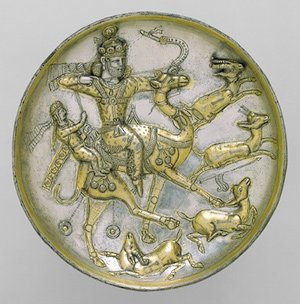
KE: I found a plate with the infamous hunting scene on it.

Working Title/Artist: Plate with Hunting Scene of Bahram Gur and Azadeh Department: Ancient Near East Culture/Period/Location: HB/TOA Date Code: 05 Working Date: photography by mma, DT1634.tif retouched by film and media (jnc) 8_26_08

Working Title/Artist: Plate with Hunting Scene of Bahram Gur and Azadeh
Department: Ancient Near East
Culture/Period/Location:
HB/TOA Date Code: 05
Working Date:
photography by mma, DT1634.tif
retouched by film and media (jnc) 8_26_08


KE: Yes, I had the same reaction. After his treatment of Azadeh I just wanted to dump Bahram into a pit of sucking sand and listen to his helpless cries as I watch him sink and choke. Frankly his story (and the stories coming in the next section, since I have been reading ahead) strike me as being more sexist in their treatment and limited view of women than the legendary tales. Bahram has no relationship with women that isn’t sexual. He demanded to be taken away from the women’s quarters at seven in a speech ripe with condescension for his female caretakers, and all of his relationships here and into the next section are basically him plucking sexy young women for his wine, hunting, and pleasure cycle.

I also noted how he regained his throne: Sure, he is advised to speak wisely, but basically he says, “Look at all these great arguments for me to become a wise king and also by the way my army will kill all of you and lay waste to your land if you don’t accept me.” The crown and the lions is just a face-saving mechanism so the Persian notables and dignitaries who have worked so hard to make sure Yazdegerd’s son doesn’t come to the throne can pretend it was a divine working.

NOT mind you that I have anything good to say about Yazdegerd. Like you, I appreciated the white horse.

I guess Bahram is a reminder of how far the farr has fallen (see what I did there?), even from the reigns of Ardeshir and Shapur I (and even Ardeshir had his unpleasant behavior toward women).

I don’t know if it’s just that the book is so long or if the transition into the historical section loses something of the mythic tone and qualities that make the legendary section so fresh and delightful to read. Ardeshir and even to some extent his son the first Shapur still had some of that sheen but now it is wearing off for me as a reader and I am strongly feeling my anti-monarchy leanings rise to the brim once again.

#

Next week: The Reign of Super Sexist Jerk Bahram Gur

(we’re doing the entire long 56 page segment the better to get quickly past the Wild Ass <== what Gur probably refers to).

Previously: Introduction, The First Kings, The Demon King Zahhak, Feraydun and His Three Sons, The Story of Iraj, The Vengeance of Manuchehr, Sam & The Simorgh, The Tale of Zal and Rudabeh, Rostam, the Son of Zal-Dastan, The Beginning of the War Between Iran and Turan, Rostam and His Horse Rakhsh, Rostam and Kay Qobad, Kay Kavus’s War Against the Demons of Manzanderan, The Seven Trials of Rostam, The King of Hamaveran and His Daughter Sudabeh, The Tale of Sohrab, The Legend of Seyavash Pt. 1, The Legend of Seyavash Pt. 2, The Legend of Seyavash Pt. 3, Forud the Son of Seyavash, The Akvan Div, Bizhan and Manizheh, The Occultation of Kay Khosrow, Rostam and Esfandyar Pt. 1, Rostam and Esfandyar Pt. 2, The Story of Darab and the Fuller, Sekander’s Conquest of Persia, The Reign of Sekander Pt. 1, The Reign of Sekander Pt. 2, The Death of Rostam, The Ashkanians, The Reign of Ardeshir & ShapurThe Reign of Shapur Zu’l Aktaf

The Reign of Shapur Zu’l Aktaf (Shahnameh Readalong 33)

Join Tessa Gratton and me as we read the Shahnameh by Abolqasem Ferdowsi. We’re using the Dick Davis translation (Penguin Classics).

This week: The Reign of Shapur Zu’l Aktaf

Synopsis: “Shapur, Lord of the Shoulders, battles against Rome after being sewn into the skin of an ass, and rules for fifty years.”

TG:  It’s strange to think of an episode that includes a king being sewn into the skin of a donkey as generally just more of the same, but that’s what it is. I enjoyed it, and would never call it boring, but these sections are beginning to feel familiar. They follow the same frame, of coming to and leaving kingship, and then the pieces are filled in with recognizable incidents, and while that can get repetitive, it really lets the details shine. Not only details like the donkey skin, but also details about the women and secondary characters, who they’re related to, and asides (like how Shapur got his epithet).

Overall there are two things I really noticed:

– I’ve gotten used to the section headings, and for the most part they only gently suggest what’s about to happen. They’re “so and so fight so and so” or “so and so is killed” or “so and so sees our hero and falls in love.” But when I got to “Shapur Travels to Rome and the Emperor of Rome Has Him Sewn in an Ass’s Skin” I had to read it twice.

And then I sat there, mouth open, and thought how I couldn’t WAIT to find out how this was going to come about, and why. It was a great reminder that sometimes a spoiler really pushes me eagerly on.

– I wonder how many descriptors of beauty are gendered. I expect most, or all, to be, but in the Shahnameh very few seem to be. I think “face like a moon” is generally used for women, but like a cypress tree, musk smelling, rosy cheeks, all these things are said of men, too. Shapur’s description in particular struck me as very “feminine” which of course made me sit back and think about my OWN assumptions and use of adjectives and metaphors and how I gender them (and play to and on reader expectations).

It’s nice in the final quarter of this epic book to feel familiar enough with the context and rhythms of it to really dig into some of these things for myself.

#

ILLUSTRATION NOTE: For the first time ever, I have not been able to find a lovely Persian miniature painting from the section we are reading this week, so have a painting of Shapur I using Emperor Valerian as a footstool to mount his horse.

shapur-1-and-valerian

#

KE:  I too felt the drum of familiarity in this section–a king in disguise as a merchant, battles and more battles, the countryside devastated, a man saved by a clever and beautiful young woman–with the notable exception of the ass’s skin. What an amazing detail!

At least the young serving girl who saves the hapless king is given a name by him. Did she have a name before or was she literally nameless? Perhaps this is a special honor name? I don’t know the customs but was pleased to see her honored because so few women get named in the saga that it’s nice to see one get her due.

The episode of the Ass’s Skin is definitely one of my small highlights of the entire book just for how strange and somewhat grotesque it is to imagine.

And yes, I do also feel we are consistently seeing a somewhat different beauty aesthetic than the one we are accustomed to. Although youthful beauty is a theme cross culturally worldwide, I suspect.

The revolt of the Nasibins also interested me; they don’t want to be ruled by a Zoroastrian king, and pay the price for it. Also note that very odd aside in which Shapur criticizes Christianity by saying, “It’s ridiculous to respect a religion whose prophet was killed by the Jews.” I don’t know any way to read this except as anti-Semitic, but maybe there is another interpretation. Neither do I have any idea of whether the Sassanians were particularly anti-Semitic, and if not, where this comes from.

Speaking of religion, I was struck by how the section concludes with a curious and unexpected mention of Mani, the founder and prophet of Manichaeism, at the end of which Mani meets a violent death (as he did in real life). Since Zoroastrianism *was* the state religion of the Sassanian dynasty, as far as I know, it makes sense that it plays a larger role in the story now. One of the things bad and simplistic history teaches is that the Muslim conquerers of Persia basically made everyone convert at the point of their swords immediately but in truth that didn’t happen at all. Zoroastrianism hung on for centuries (and there is still a remnant community), and often people converted either out of piety or because it benefited them in some way. I don’t think the Book of Kings will get into that, though, since we’ve already been told that Islam is never mentioned in the story although Ferdowsi wrote after the Islamic conquests.

So I peeked ahead to the reign of Yazdegerd the Unjust and I can just say that Yazdegerd’s son Bahram looks to be the nastiest toward women yet. Imagine my emoji face.

#

Next week: The Reign of Yazdegerd the Unjust

Previously: Introduction, The First Kings, The Demon King Zahhak, Feraydun and His Three Sons, The Story of Iraj, The Vengeance of Manuchehr, Sam & The Simorgh, The Tale of Zal and Rudabeh, Rostam, the Son of Zal-Dastan, The Beginning of the War Between Iran and Turan, Rostam and His Horse Rakhsh, Rostam and Kay Qobad, Kay Kavus’s War Against the Demons of Manzanderan, The Seven Trials of Rostam, The King of Hamaveran and His Daughter Sudabeh, The Tale of Sohrab, The Legend of Seyavash Pt. 1, The Legend of Seyavash Pt. 2, The Legend of Seyavash Pt. 3, Forud the Son of Seyavash, The Akvan Div, Bizhan and Manizheh, The Occultation of Kay Khosrow, Rostam and Esfandyar Pt. 1, Rostam and Esfandyar Pt. 2, The Story of Darab and the Fuller, Sekander’s Conquest of Persia, The Reign of Sekander Pt. 1, The Reign of Sekander Pt. 2, The Death of Rostam, The Ashkanians, The Reign of Ardeshir & Shapur

The Reigns of Ardeshir & Shapur (Shahnameh Readalong 32)

Join Tessa Gratton and me as we read the Shahnameh by Abolqasem Ferdowsi. We’re using the Dick Davis translation (Penguin Classics).

This week: The Reign of Ardeshir AND The Reign of Shapur, Son of Ardeshir

Synopsis: “Ardeshir rules wisely and makes many changes to the laws of the land. He also likes to kill the ladies.”

TG:  “When Ardeshir killed Ardavan and grasped the world in his fist” is a GREAT opening line to a story.

I’m enjoying how these episodes are taking stories and story-lines we’ve encountered before and giving them different endings or twisting them. For example: Ardeshir wants to see if his soul will respond to the sight of his son, so has 100 boys dressed up as look alikes. He has faith he’ll recognize him, but it also testing the farr and their royal connection. Given the tendency in the Shahnameh for fathers and sons to NOT recognize each other — to great tragedy– I am really nervous for Shapur who I haven’t even met. But this time, it works out. And then we do the same thing with Shapur’s secret son! Ardeshir recognizes his farr and lineage in the exact same way: through polo. Such a great storyline! And it plays on my emotions because I do not expect it to work out.

It’s interesting that Ardeshir fears someone will cast an evil eye upon Shapur when that’s so similar to the vizier’s fear that someone who is in enemy will poison his water. This new fear of the power of enemies to curse or slander is a culture shift, I think. Earlier, the power of an enemy was all about the sword. People made choices to hide secret sons or rescue condemned prisoners because of prophecy or stars, not because of a vague fear of curses. It’s as if magic has disseminated into the population, instead of just being the tool of wizards (I miss you Zal!) and demons.

We’re also getting more of these stories where farr and beauty mark a person royal even if they’re hidden among the peasants, “Like a tulip among weeds.”

It’s interesting, too, that Ardeshir makes so many thoughtful reforms, but really likes killing women. He wants to cut off their heads or hang them or, notably, burn them alive! “Interesting.” Mostly I mean that he’s clearly supposed to be a king we respect, and yet….

“Religion cannot do without the king, and the king will not be respected without religion” I wonder if this is true? I know they can build each there up, create support structures for each other, but to what extent can they survive without the other? We have evidence that religion can survive without a king just fine, but at least in the West, I’m not sure we can say the same about kings. Religious rebellion and changing philosophical perspectives is one of the things that leads to uprising against kings in western history. We rely upon the Divine Right of Kings, and without that divine right… why is the king the king? I suspect in the Shahnameh this is directly related to farr, and that only a person with farr can be king, and farr itself comes from God.

“That man who lifts a wine glass in his hand/In memory of the kings who ruled this land/Knows happiness” is going to be the epigraph of a book I wrote someday. Or short story. We shall see.

Here are a few brief notes I took down:

– It’s funny the note that Ferdowsi gives about brief accounts of uneventful kingships, when the one we just read about Shapur is really brief and uneventful, too. It was more like an epilogue to Ardeshir’s section.

– Self castration takes…balls. This entire episode delighted me.

– I’d like to know the protocols of wine drinking.

– We got a girl at the well story!

– “Scribes are the unseen rulers of the kingdom” can I put that on my business cards?

– I fear the reason we haven’t heard more from Golnar is because she’s dead, since Ardeshir really likes to kill the ladies.

golnar-looking-out-the-window

Golnar looks out a second story window and sees handsome young Ardeshir for the first time. <3s!

KE:  I am going to figure out a way to write a story about Golnar because I too want to know what happened to her. Or make up my own triumphant ending for her, because she is aces.

I love the girl at the well story, and even better, she is in fact the missing daughter of Mehrak, who is referenced and then to my excitement brought back into the tale in an important role. I am intrigued by how many women Ardehir’s story includes, because even if he does want to kill most of them (or discards the much missed Golnar), they are still there: his mother, the slave Golnar, Arnazad’s nameless daughter the poisoner, and Mehrak’s daughter. That’s a lot of women! And they all do such active things, which is what intrigues me most. Think about it: everything these women do in this section are all perfectly reasonable things for historical women to have done, and in the way they have done them and for the reasons they do them.

The girl in the well also matters to me because of its Biblical parallels. In the Bible, girls at wells drawing water for tired and thirsty animals are seen as desirable because of their compassion, while Shapur sees “radiance” and “signs of royalty” in her face. He actually says, “No peasant ever had a daughter as lovely and as bewitching as you are.” Which I don’t adore as a sentiment, but it is what it is, and yet at the same time, her father Mehrak is described as “low-born” so I don’t know what to make of that.

Shapur defeats the Romans (I love being in historical times) and then uses Roman engineering! Smart man.

Ardeshir’s reforms are really interesting and also fit a pattern. It feels like dynasty founders follow similar paths. In fact, these “discovery of the royal child amid ordinary children” stories are both reflections of a story from Cyrus the Great’s childhood, so I have to wonder if they got their start there or if, like the stories of Moses and Sargon being cast into the river in a basket as babies, they represent a kingly origin tradition tale. It does feel as if these warring conquerers then, once they’ve got theirs, turn around and immediately start working to keep it together by instituting a strong legal system and to keep their legacy untarnished by declaring themselves for justice, mercy, and other such reforms. I don’t know. But one does see it over and over again in the history of the world.

Now that we’ve entered historical times, people die at normal ages rather than 800. Onward into the Sassanian dynasty!

Next week: The Reign of Shapur Zu’l Aktaf

Previously: Introduction, The First Kings, The Demon King Zahhak, Feraydun and His Three Sons, The Story of Iraj, The Vengeance of Manuchehr, Sam & The Simorgh, The Tale of Zal and Rudabeh, Rostam, the Son of Zal-Dastan, The Beginning of the War Between Iran and Turan, Rostam and His Horse Rakhsh, Rostam and Kay Qobad, Kay Kavus’s War Against the Demons of Manzanderan, The Seven Trials of Rostam, The King of Hamaveran and His Daughter Sudabeh, The Tale of Sohrab, The Legend of Seyavash Pt. 1, The Legend of Seyavash Pt. 2, The Legend of Seyavash Pt. 3, Forud the Son of Seyavash, The Akvan Div, Bizhan and Manizheh, The Occultation of Kay Khosrow, Rostam and Esfandyar Pt. 1, Rostam and Esfandyar Pt. 2, The Story of Darab and the Fuller, Sekander’s Conquest of Persia, The Reign of Sekander Pt. 1, The Reign of Sekander Pt. 2, The Death of Rostam, The Ashkanians

The Ashkanians (Shahnameh Readalong 31)

Join Tessa Gratton and me as we read the Shahnameh by Abolqasem Ferdowsi. We’re using the Dick Davis translation (Penguin Classics).

This week: The Ashkanians

Synopsis: “The post-Sekandar world is less grandiose than before, with many short-lived kings and an even shorter-lived peace, but we do get a great story about a demon-worm.”

TG: The introduction to this section was fascinating, as it basically said “here’s what we’re going to talk about, and it’s not really worth talking about, in fact, we know almost nothing about these kings but their names,” and then the section proceeds to go into a lot of detail.

I wonder what the purpose of it was — to assure us that we don’t have to worry about another great character like Sekandar? To relate listeners to an episode of history that I’m not familiar with?

That said, this section presented some unique moments (not even including the worm). Babak’s reaction to his dream prophecy was a pleasant surprise, in that he didn’t get jealous or angry, but instead welcomed this strange prince into his life and allowed Sasan to become his son, and then for Ardeshir to be born.

And Golnar! The king’s treasurer. She’s not just any slave or mistress, she’s trusted with the kingdom’s funds, and no matter what else you can say about Ardavan, he loved her, even refusing to start his days without seeing her face for a good omen. That was charming. But Golnar takes destiny (and the story) into her own hands by climbing out of her bower to chase love in the form of Ardeshir. She gives up everything, risks her life, and even uses her power over the treasury to steal from Ardavan. If only she didn’t disappear entirely once she served her purpose. I was hoping to discover who her sons and daughters are by Ardeshir. OH WELL.

And then the worm. What a great fairy tale, and it fits into the story here seamlessly. I love the overlooked daughter who finds the worm and instead of fearing it, gives it a home and uses its luck. Too bad this turned into her father’s story instead of her own. So it goes. But at least I can imagine she survives and finds continued happiness and success in the rest of her life.

Here’s a picture of Ardeshir killing the worm: 

ardeshir-kills-worm

King Ardeshir in disguise as a merchant pours hot lead down the throat of the giant worm, which lives in a cistern. His three cronies stand alongside, watching.

And here the girls spinning (I’m fascinated by their spindles)(the piece is a detail from a larger 16th century painting called “The Story of Hafted and the Worm):

girls-spinning-shahnameh

five young women seated cross-legged on the ground, amid trees, spinning thread.

KE: The historical discussion here fascinates me. Sekander “kills all the kings” which I would kind of assume must reference his conquest of the Persian Empire and replacing most (although not all) of the local level kings and rulers with Macedonian and Greek men from his army. So there is a violent break in terms of rulership to some degree (although studying the Seleucid period shows that it isn’t a clean a break as one might think, and it certainly didn’t involve any major changes in the general population demographics). But the narrative seems to skip over the Seluecid period and to a fair extent the Parthian period, as the Ashkanian period seems to include a number of local and regional level rulers without one overall Iranian king as in the previous dynasty.

Maybe this was just me, but I did feel that Ardeshir’s narrative has less of a legendary aura to it and felt more realistic. Everything that happens to him (even to some extent the story of the worm with the cunning way he kills it) feels completely believable in the sense that it could easily be translated directly into the plot of a novel and make pragmatic sense. Rostam always feels larger than life. Ardeshir feels like a dude doing things to make his way, and his story also makes political sense, for example, with the idea of him fostering at the court of a more powerful king whom he eventually supplants. Also I loved his charming correspondence with his beloved grandfather, to whom he is evidently closer than his own father.

While I’m on that, how savvy and level-headed is Babak anyway? Seeing how the stars reference this young shepherd as a future king or sire of kings, does he try to murder the man? NO. He promptly marries him off to his daughter so that he, too, can be connected to this coming line of kings. I loved that.

I too loved the story of the worm but I’m sorry we never hear what became of the daughter (the one, the story tells us, that her father never thought about, which is then contrasted with her actions bringing about his wealth and power). I thought her sparing the worm was a nice action but I guess it wasn’t? I never figured it out, and she vanishes from the story, still nameless. Alas. Together with the unnamed daughter of Mehrak, who is the only one of his family not put to the sword, because she manages to hide out. Will we see her again in the next chapter? Or is she yet another woman’s story hinted at and left untold? It’s no wonder I write the books I do, centering women.

Finally, I just absolutely have to do a retelling of Golnar’s story because it completely took hold of me and I, too, was irritated that we never hear about her again (unless she turns up in the next chapter, but I have to assume that Ardeshir’s heir will be by the princess, not the slave)(although you never know).

Oh, one last thing. For all his legendary status and heroics, Rostam really is a life that flares brightly and yet leaves nothing but his reputation upon his death (although that is considerable), while the hero Esfandyar is now one of the ancestors of the new dynasty and mentioned as such.

Next week: The Reign of Ardeshir & The Reign of Shapur, son of Ardeshir

Previously: Introduction, The First Kings, The Demon King Zahhak, Feraydun and His Three Sons, The Story of Iraj, The Vengeance of Manuchehr, Sam & The Simorgh, The Tale of Zal and Rudabeh, Rostam, the Son of Zal-Dastan, The Beginning of the War Between Iran and Turan, Rostam and His Horse Rakhsh, Rostam and Kay Qobad, Kay Kavus’s War Against the Demons of Manzanderan, The Seven Trials of Rostam, The King of Hamaveran and His Daughter Sudabeh, The Tale of Sohrab, The Legend of Seyavash Pt. 1, The Legend of Seyavash Pt. 2, The Legend of Seyavash Pt. 3, Forud the Son of Seyavash, The Akvan Div, Bizhan and Manizheh, The Occultation of Kay Khosrow, Rostam and Esfandyar Pt. 1, Rostam and Esfandyar Pt. 2, The Story of Darab and the Fuller, Sekander’s Conquest of Persia, The Reign of Sekander Pt. 1, The Reign of Sekander Pt. 2, The Death of Rostam

The Death of Rostam (Shahnameh Readalong 30)

Join Tessa Gratton and me as we read the Shahnameh by Abolqasem Ferdowsi. We’re using the Dick Davis translation (Penguin Classics).

This week we present an out of order chapter, the long-awaited podcast (hosted by the brilliant and magnificent Renay of Fangirl Happy Hour and Lady Business) in which you can hear Tessa and I discuss in person with each other the project, and the death of the great hero Rostam, about which we have many complicated thoughts.

Here’s an image of his death together with his loyal horse Rakhsh.

2-death-of-rostam

Find this week’s discussion on the Fangirl Happy Hour podcast.

Here’s another image of his death, using marquetry (inlaid wood):

death-of-rostam

Next week: We hop back to the regular sequence and, after the death of Sekander, continue on with The Ashkanians.

Previously: Introduction, The First Kings, The Demon King Zahhak, Feraydun and His Three Sons, The Story of Iraj, The Vengeance of Manuchehr, Sam & The Simorgh, The Tale of Zal and Rudabeh, Rostam, the Son of Zal-Dastan, The Beginning of the War Between Iran and Turan, Rostam and His Horse Rakhsh, Rostam and Kay Qobad, Kay Kavus’s War Against the Demons of Manzanderan, The Seven Trials of Rostam, The King of Hamaveran and His Daughter Sudabeh, The Tale of Sohrab, The Legend of Seyavash Pt. 1, The Legend of Seyavash Pt. 2, The Legend of Seyavash Pt. 3, Forud the Son of Seyavash, The Akvan Div, Bizhan and Manizheh, The Occultation of Kay Khosrow, Rostam and Esfandyar Pt. 1, Rostam and Esfandyar Pt. 2, The Story of Darab and the Fuller, Sekander’s Conquest of Persia, The Reign of Sekander Pt. 1, The Reign of Sekander Pt. 2

The Reign of Sekander – part two – (Shahnameh Readalong 29)

Join Tessa Gratton and me as we read the Shahnameh by Abolqasem Ferdowsi. We’re using the Dick Davis translation (Penguin Classics).

If you haven’t already don’t forget to check out this  AMAZING post by Rachel W in which she works out the complicated genealogy of our main and secondary characters.

This week we are again skipping over The Death of Rostam and continuing on with the first part of The Reign of Sekander. Tessa and I, with the assistance of the able Renay of blog Lady Business and podcast The Fangirl Happy Hour, recorded a 30 minute conversation about our feelings about The Death of Rostam. We will post that for your listening pleasure as soon as Renay has edited it to her satisfaction so soon. Meanwhile, we forge onward.

Synopsis: “The second part of Sekandar’s reign, during which he travels the known world, seeking knowledge and power, until he dies of illness in Babylon.”

TG: This section alone feels like it could have been 500 pages of adventuring. So much happened, so many lands and people were visited, and they were all fascinating! I caught myself several times trying to figure out what places and cultures they were referencing. Obviously the women of Harum are connected to stories of the Amazons, with their matriarchy and manly left breast. Possibly some of the naked, blue-faced barbarian fighters were Celts or Norseman? I’m most interested in the city where the “men have soft feet!” What does that mean?

Sekandar continues to use his trickster ways, which is not only fun, but a very consistent characterization. He tries yet AGAIN to gain information from a king by pretending to be his own envoy! His army must just have gotten used to it. I was especially surprised he uses trickery to kill the dragon by filling the cow-skins with poison. That doesn’t seem very heroic to me — I can’t imagine Rostam killing a dragon like that. And yet, it works, and Sekandar is praised for it.

The most interesting thing to me in all his wandering were the frequent death visions: Sekandar saw several corpses, seeming to symbolize his fate. The dead king high on the mountain, surrounded by treasure and fame, but still dead. The angel Esrafil told him his death would come soon. The speaking tree gave him a precise time of death…. it seems no matter how far Sekandar searched out answers and curiosities, he always had to be reminded that death could not be defeated or solved. He didn’t even achieve the Waters of Life (though it seems his friend Khezr does, and then we hear no more of him?!?).

It was neat to see Arestalis come back in, and bestow wisdom to Sekandar, who then listened to that wisdom absolutely, even though it was connected to his death.

And I loved that Sekandar’s final words of wisdom, which in previous episodes have been relayed from dying king to his son and heir, Sekandar gave to his mother.

I do feel like the Shahnameh is taking a big turn as we leave Sekandar behind, the “world is changing” as Sekandar keeps being told, and the time of epic heroes may be passing as we get more and more connected to real history.

sikander-kills-dragon

Sekander kills the dragon

KE: I’m dealing with multiple things going on at the same time so I don’t have any extensive commentary except that I loved this. The whole Sekander section has fascinated me both for historical and psychological reasons, and this final segment has such a fabulist and yet also deeply philosophical aesthetic that it was a delight to read. He is always asking questions. There is, I think, a direct correlation thematically between his wanting to “conquer the world” and also to answering the big questions, including the most important one, about death, and of course there is no way to defeat death as the stories tell us over and over again.

Every episode in this sequence was amazing, from the city of women (where they allow him alone to sneak in and look around) to the wonders, and the death visions, and the final letters to his teacher and his mother.

And, yes, I can’t help but love that the only person to see through his trickster-envoy ways is still, and always, Queen Qaydafeh.

Like you, I feel that the tenor of the story must now change, that maybe we are leaving behind the mythic and entering history.

Next week: The Ashkanians

 Previously: Introduction, The First Kings, The Demon King Zahhak, Feraydun and His Three Sons, The Story of Iraj, The Vengeance of Manuchehr, Sam & The Simorgh, The Tale of Zal and Rudabeh, Rostam, the Son of Zal-Dastan, The Beginning of the War Between Iran and Turan, Rostam and His Horse Rakhsh, Rostam and Kay Qobad, Kay Kavus’s War Against the Demons of Manzanderan, The Seven Trials of Rostam, The King of Hamaveran and His Daughter Sudabeh, The Tale of Sohrab, The Legend of Seyavash Pt. 1, The Legend of Seyavash Pt. 2, The Legend of Seyavash Pt. 3, Forud the Son of Seyavash, The Akvan Div, Bizhan and Manizheh, The Occultation of Kay Khosrow, Rostam and Esfandyar Pt. 1, Rostam and Esfandyar Pt. 2, The Story of Darab and the Fuller, Sekander’s Conquest of Persia, The Reign of Sekander Pt. 1

The Reign of Sekander- part one – (Shahnameh Readalong 28)

Join Tessa Gratton and me as we read the Shahnameh by Abolqasem Ferdowsi. We’re using the Dick Davis translation (Penguin Classics).

If you haven’t already don’t forget to check out this  AMAZING post by Rachel W in which she works out the complicated genealogy of our main and secondary characters.

This week we are again skipping over The Death of Rostam and continuing on with the first part of The Reign of Sekander. Tessa and I, with the assistance of the able Renay of blog Lady Business and podcast The Fangirl Happy Hour, recorded a 30 minute conversation about our feelings about The Death of Rostam. We will post that for your listening pleasure as soon as Renay has edited it to her satisfaction so soon. Meanwhile, we forge onward.

Synopsis: “The first part of Sekandar’s reign, during which he conquers several kingdoms, some with friendship, some with trickery, some with war.”

TG: I continue to find Sekandar delightful — I love that he refuses to give up his penchant for trickery and pretending to be who he’s not. It keeps him seeming youthful and very entertaining.

While the episode with Foor was pretty typical of episodes in the Shahnameh so far, the ways Sekandar allies himself with Kayd and Qaydafeh are very unique and fascinating.

Kayd’s defense of his land by giving up the four special gifts is so reminiscent of a fairy tale I could read it again and again, and yet the specifics ground it so firmly in Shahnemeh folklore and language I just am in love. The battle of wits that’s really a riddle game, the fairy princess, the goblet that will not be drained (not to mention the actual description of the rules by which that magic works! Be still my wizard heart!)… I was in heaven during this section.

And it’s about time we had a queen who not only rules and rules well, but who out-smarts Our Hero, and delights in doing so. She makes Sekandar blush, and laughs at him and her own prowess. I love Qaydafeh with all my heart.

The one thing that kept pulling me out of this was the anachronistic association between Sekandar and the cross, not to mention the explicit references to Christianity. Historical Sekandar lived ~300 years before Christ, and nothing in the Shahnameh so far has reminded me that it was written down hundreds of years after the events took place — if they took place — and that it likely stems from oral traditions unconcerned with chronology and documentation. This is also the first time, I believe, that Mecca is explicitly mentioned and as a holy city of God, not to mention the invocation of Abraham and his line of descendants. VERY interesting.

iskandar-qaydafeh

Qaydafeh taking no crap from Sekander as she shows him his lying face

KE: Yes, I really love how Sekander is portrayed in this. He is a great character (second only to Seyavash in my heart now).

But how fantastic is Qaydafeh!!! Note that she is an older woman, with grown sons, not a sexy princess available as a sexual partner. In fact, and this is really interesting to me, Sekander also communicates respectfully with Delaray, the mother of Roshanak-whom-he-marries), so there is a pattern here of showing him in relationships with older women that I find quite interesting (and not at all common either in the Shahnameh or in narrative in general).

But I have to quote from this simply adorable passage in which Qaydafeh calls out Sekander. How often have women thought (and less often said) this:

Qaydafeh laughed at his blustering manliness and his angry words. She said, “O lion-like king, don’t let yourself be led astray by your male pride!”

That she completely overturns the expected power dynamics between them is GOLD to me. GOLD. I could not stop laughing when she drops the portrait of him in his lap to let him know she knows who he really is.

Although Seyavash will always be in my heart, this may be my favorite sequence in the Book of Kings so far. Qaydafeh is never punished for being smart and wise and powerful. Her power is not upended (at least not so far). And given where part one left off (at page 500) I will be fascinated to see how she handles the apparent betrayal of her reckless and unwise younger son, Taymush, whom she has given permission to Sekander to school, as it were.

Whenever a well known historical Alexander episode pops up here I’m just so intrigued, for example the mutiny of the army and their complaint, which is a classic episode from the Western versions of his history as well.

Like you I’m fascinated by the presence of Christianity and Islam inserted into an historical period where they didn’t exist. Especially given the presence of Zoroastrianism during Esfandyar’s story. I don’t have any comment on it beyond how interesting it is to see the historical events of Sekander’s reign conflated with the present-day understanding of Ferdowsi’s world, in which the West WAS Christian and the Middle East WAS Muslim. Makes you think about how we create historical narrative in our own time, doesn’t it?

#

Next week: the second part of The Reign of Sekander

 Previously: Introduction, The First Kings, The Demon King Zahhak, Feraydun and His Three Sons, The Story of Iraj, The Vengeance of Manuchehr, Sam & The Simorgh, The Tale of Zal and Rudabeh, Rostam, the Son of Zal-Dastan, The Beginning of the War Between Iran and Turan, Rostam and His Horse Rakhsh, Rostam and Kay Qobad, Kay Kavus’s War Against the Demons of Manzanderan, The Seven Trials of Rostam, The King of Hamaveran and His Daughter Sudabeh, The Tale of Sohrab, The Legend of Seyavash Pt. 1, The Legend of Seyavash Pt. 2, The Legend of Seyavash Pt. 3, Forud the Son of Seyavash, The Akvan Div, Bizhan and Manizheh, The Occultation of Kay Khosrow, Rostam and Esfandyar Pt. 1, Rostam and Esfandyar Pt. 2, The Story of Darab and the Fuller, Sekander’s Conquest of Persia

Sekander’s Conquest of Persia (Shahnameh Readalong 27)

Join Tessa Gratton and me as we read the Shahnameh by Abolqasem Ferdowsi. We’re using the Dick Davis translation (Penguin Classics).

If you haven’t already don’t forget to check out this  AMAZING post by Rachel W in which she works out the complicated genealogy of our main and secondary characters.

This week we are again skipping over The Death of Rostam and continuing on with Sekander’s Conquest of Persia. Tessa and I, with the assistance of the able Renay of blog Lady Business and podcast The Fangirl Happy Hour, recorded a 30 minute conversation about our feelings about The Death of Rostam. We will post that for your listening pleasure as soon as Renay has edited it to her satisfaction so soon. Meanwhile, we forge onward.

This week: Sekander’s Conquest of Persia

Synopsis: “Sekandar invades Persia and defeats the king Dara in a series of epic battles. Dara is murdered by his own advisors, allowing Sekandar the entire imperial throne.”

TG: This section was very entertaining, and surprisingly heart-wrenching: first of all for how much I liked Sekandar as a character. He has a bit of the trickster in him, for how he goes to Dara’s court in disguise in order to judge Dara for himself and gather intel on the actual extent of Dara’s army.

Second of all, for the tension inherent in Dara and Sekandar being half-brothers. I didn’t expect them to find out, but I knew, and it stressed me out because of how tragically all previous episodes involving secret family members have gone. There WAS a moment I thought Dara might figure it out…when he recognized the disguised Sekandar as having farr and surely being from the same famous bloodline. (It was interesting a ruling king would admit another king might have the farr–seems dangerous to me, like it legitimized Sekandar’s claim and invasion, though I suppose one cannot deny farr.)

It was a great bit of story-telling in the very beginning how the narrative puts Dara and Sekandar in parallel but opposing roles as rulers: Dara rejects advisors when he takes the crown, but the first thing we learn about Sekandar is that he listens to the wise counselor Arestalis (I assume this is the same personage as Aristotle). It not only held up the brotherhood tension, but also put into place the characterization that neither of them is a BAD king. Though Dara is hot-tempered and arrogant, he treats his army very well and gives money to the poor. Sekandar seems well-loved, though we have less textual evidence of why so far.

Neither fights initially for entirely selfish or egotistical reasons: Sekandar doesn’t want to pay a tax for which he gets nothing in return, which I have sympathy for, and Dara is putting down a rebellion. Though Dara should’ve given up earlier for the sake of his army and people, and Sekandar seems genuine in his desire to resolve their differences peacefully, I can’t really imagine a true son of Dara’s bloodline surrendering. It’s not in their nature, as we’ve seen over 450 pages of story.

The death scene was very poignant to me — because I genuinely enjoy Sekandar for his trickster qualities and chivalry, and also because I’m never taught to dislike Dara. The image of Dara’s dying head on Sekandar’s thigh will stay with me, and I’m glad Dara’s traitorous advisors were executed. “It seemed his skin would split with sorrow” is an amazing line, as is “my part in the fires of life is now merely smoke.”

A final note: Though not yet as beloved to me as Seyavash, I feel like I’m really getting a solid idea as to Sekandar’s personality and I love what I see. He seems like a combination of the Persian heroic/kingly temperament and the only good parts of Rostam (his passion and willingness to play the trickster). Maybe if Zal had become a warrior king instead of a sorcerer he’d have been just like this. HERE’S HOPING SEKANDAR DOESN’T LET ME DOWN.

sekander & dying Dara

painting of Sekander weeping as he cradles the head of the dying Dara on his lap

KE: What a fascinating retelling of the story of Alexander the Great. First, I can’t help but note how in this version of the story the Persians claim him as one of their own people, thus giving a justification for his conquest of what is clearly the mightiest nation in the region at that time. Because Sekander is also the son of a Persian king (according to this origin story) then it’s also a form of destiny that he becomes king.

The history follows reasonably closely too, including the reference to Aristotle. Alexander’s trip to Egypt is mentioned. Three major battles are listed, and Dara (like Darius) is struck down by one of his own supporters and left to die. Alexander executed the man who killed Darius and afterward claimed that Darius had passed the crown to him. Also there is a mention of all the negotiations over the families of the court, which is a major part of the Alexander history/legend.

I also really enjoyed the characterization of Sekander here. He has all the typical attributes given to kings yet with that playful or trickster or slightly reckless attribute that causes him to pretend to be his own envoy in a really wonderful scene. The characterization of Dara also appealed to me, strangely enough. He had an immediacy and roundedness in being described as “young, fiery-tempered, quick to take offense, and his heart and tongue were hard enough to blunt a sword.” Probably this personality type is a little too appealing to me in the narrative sense, to my shame. When he raises the pay of his troops I have to wonder if this is a play to make sure the army remains loyal to him while the nobles (often jockeying for power in the court) can’t undermine him. But that’s just me. I mean, this is the stuff that epics are made of.

Like you, I was surprised that Dara and Sekander were always respectful and courteous to each other and never fell into what I can only call the dick-waving contest of, say, Esfandyar and Rostam’s famous interactions. In fact, they acknowledge they are related in the very touching death scene.

One last curiosity: Sekander’s army is described as flying “the beloved cross . . . embroidered in red” on its banners (together with a bird). Is this a reference to Christianity? In which case, an element out of time. I don’t know.

#

Next week: Either The Death of Rostam podcast OR part one of The Reign of Sekander

 Previously: Introduction, The First Kings, The Demon King Zahhak, Feraydun and His Three Sons, The Story of Iraj, The Vengeance of Manuchehr, Sam & The Simorgh, The Tale of Zal and Rudabeh, Rostam, the Son of Zal-Dastan, The Beginning of the War Between Iran and Turan, Rostam and His Horse Rakhsh, Rostam and Kay Qobad, Kay Kavus’s War Against the Demons of Manzanderan, The Seven Trials of Rostam, The King of Hamaveran and His Daughter Sudabeh, The Tale of Sohrab, The Legend of Seyavash Pt. 1, The Legend of Seyavash Pt. 2, The Legend of Seyavash Pt. 3, Forud the Son of Seyavash, The Akvan Div, Bizhan and Manizheh, The Occultation of Kay Khosrow, Rostam and Esfandyar Pt. 1, Rostam and Esfandyar Pt. 2, The Story of Darab and the Fuller

The Story of Darab and the Fuller (Shahnameh Readalong 26)

Join Tessa Gratton and me as we read the Shahnameh by Abolqasem Ferdowsi. We’re using the Dick Davis translation (Penguin Classics).

If you haven’t already don’t forget to check out this  AMAZING post by Rachel W in which she works out the complicated genealogy of our main and secondary characters.

This week we are skipping The Death of Rostam and discussing the next chapter, The Story of Darab and the Fuller.

Why? you may ask. Because Tessa and I, with the assistance of the fabulous Renay of blog Lady Business and podcast The Fangirl Happy Hour, recorded a 30 minute conversation about our feelings about The Death of Rostam. We will post that for your listening pleasure as soon as Renay has edited it to her satisfaction so perhaps next week or the week after. Meanwhile, we forge onward.

THIS WEEK: The Story of Darab and the Fuller

Synopsis: “The story of King Darab, who was raised by a fuller and had an awesome mother.”

TG: All the stories about Homay, please.

Homay, daughter of Bahman, makes herself queen after her father dies. She “places the crown on her own head” and tells the whole world not only is she queen now, but she’s gonna be a great one: then she proceeds to do exactly that.

I love that this story gives her honor and glory, doesn’t try to undercut her power. And I love that she’s the first king to want to keep the throne for herself who then succeeds in doing so! The threat to her crown is her son, and instead of having him killed or banished or concocting a long-game scheme to get rid of him, she gives him to the river, with riches and guardians. It works! The people who find him raise him well enough, to be practical in addition to letting his farr develop and grow bright.

It was interesting to me that Darab’s farr shows up as beauty, a warrior’s glory and prowess, and a certain, shall we say, attitude. He feels that his parents are not his true parents, and he feels that he comes from elsewhere. His feelings make him a bit of an ass to his parents, but that’s in keeping with the behavior of famous princes and warriors like Rostam. I also see parallels to Zal a bit, who was raised by magic, because Darab WAS given to the river, and even though there’s no explicit magic there and his foster parents were humans (though humans who bend the river to their will by narrowing it), it seems like the land takes an interest in him, for it’s the wind itself protecting him from the ruins later in his life. That moment of earth magic was lovely and exciting. Of course, Zal would never turn a wife away bc she had bad breath! (I loved that story though, and really look forward to Sekandar, named after a semi-magical healing herb.)

Homay seems to change her tune when she realizes her son has come home–she’s happy to see him, according to the narrative, but tells a slightly different story. At first, when Darab was a baby, she “enjoys” the fact that she’s the queen of everything, but she tells Darab and the priests when he returns that she is so glad to turn the throne over to him because it and her wealth have “caused me such sorrow.” I want to think that she’s saving her own skin by acting apologetic and as if she did this because she HAD to, to save the kingdom for Darab. I wouldn’t put it past her.

My favorite moment of this entire section though, is when Darab forgives Homay for sending him away, because IT MAKES A BETTER STORY. He actually says to her that he’s glad she gave him to the river, because nobody will forget him now. That is delightful, and insightful of him. And also pretty meta, given that this is the Book of Kings and I’m certainly going to remember this section better than some of the others.

A last note: these kings seem to be living normal lifespans now. Growing old and sick, dying in time for their children to inherit, instead of living for hundreds of years and having to be ousted.

Homay crowning Darab

Homay crowns Darab, although as far as I can tell Darab is sitting the audience chamber and Homay is on a balcony observing the crowning rather than doing the crowning with her own hands

KE:  Wow, I could write a hundred pages about this story alone because there is so much of interest here.

The story has a very folk-tale like feel to it, complete in itself and with the delightful element of the baby placed in water and recovered by people who adopt it (as also seen in the stories of Moses and of Mesopotamian king Sargon). As Tessa points out, Darab’s growth reflects elements of earlier stories. Of course Darab’s high birth asserts itself despite his lowly upbringing; of course he is recognized as superior to others, etc etc. This is a trope still beloved in our modern fiction complete with the mismatched family element (Harry Potter!). These days it might also be a random gifted person, not just a descendent of noble blood, who is plucked from obscurity and returned to their rightful status as someone on top of the heap (whether that heap be rulership, art, science, or what have you). Regardless, the trope of essentialism, of “blood tells,” of Chosen Ones and the hierarchy of “natural worth” is quite interesting for how long it has been with us and how it persists even in a supposedly democratic egalitarian society.

I want to add that Darab was really a dick to his foster parents which I can in no way from the story detect that they deserved, except, I suppose, that it might be implied they should have never tried to pretend (to him) that he was really theirs. I did not like the way he treated them, and of course in a story of this kind he is never scolded, punished, or made to look bad for his rudeness and dismissiveness. Birth and farr give him the right to be the way he is.

I too loved Homay. What interested me most beyond the unusual aspect of a woman ruling alone and competently (that is, the story allowing it) was the unexplained and never explored aspect of her relationship to her father. Her father has sex with her. Because we are given a synopsis for this very unexpected situation rather than the full poetic treatment, we can’t know whether Homay is a willing participant. Is she okay with it because it gives her power? Why does her brother leave in anger? He must suspect that he’s about to get disinherited. Is there shame in Homay having a child by her father? Is that one reason for her to claim the child is dead and get rid of it (without killing it, since she seems too righteous to do that)? Is it purely ambition that drives her, knowing that she could be nothing but a regent as long as a boy child exists? And if so, then everyone would have to acknowledge that this is a child born through incest, even though there is a “custom called Pahlavi” which I looked up in iranica online:

In Zoroastrian Middle Persian (Pahlavi) texts, the term xwēdōdah (Av.xᵛaētuuadaθa) is said to refer to marital unions of father and daughter, mother and son, or brother and sister (next-of-kin or close-kin marriage, nuclear family incest), and to be one of the most pious actions possible. The models for these unions were found in the Zoroastrian cosmogony. 

The pre-Alexander Achaemenid Empire, the one he conquered, includes marriages among the noble clans that may be quite close relation. I don’t know what it means in the Zoroastrian cosmogony but politically it can sometimes make sense to marry next of kin or close kin to keep power tied tightly within the hands of a single family.

I also have to wonder if Darab and Dara have any etymological link to the King Darius whom Alexander defeated, but I just don’t know. We are falling sideways into history, and it is so interesting to see the origins of the next story which we know from a different place in Western history.

Which leads me to the next interesting thing: Hey! Alexander! How fascinating to suggest Sekander (the Persian form of Alexander) is half Persian! Why not? His origin story is fascinating. I too was bemused by Darab putting his wife aside because she has bad breath. What a curious detail.

A couple of interesting mentions regarding Filqus, named here as the king of Greece. Is Filqus related at all etymologically to Philip (Alexander’s actual father)? I have no idea. Anyway, he’s said to be in league with the king of Susa, and now after all these stories about legendary kings I do feel we are stepping firmly into history. I don’t know where Amourieh is meant to be; I found one reference to it saying it is the district between the River Jordan and the Mediterranean, in which case Filqus would not be the king of Greece (Hellas) or Macedonia but rather of what we now call Lebanon and Israel. How curious!

Narratively it feels as if Darab’s choice to send her back to her father reflects a long tradition within the Shahnameh of boys being brought up by their mother’s in their mother’s courts with no knowledge or interaction with their fathers. It’s just so interesting, and of course sets up the next story, which is Sekander’s conquest of Persia.

Randomly, as I searched for images of Homay, I found this image of the cover of a book about (as the title so clearly states) Women in the Shahnameh. Hmm. Could be interesting.

cover WOMEN IN THE SHAHNAMEH

Next week: Either the podcast version of The Death of Rostam OR if that’s not ready yet, the first part of Sekander’s Conquest of Persia. JOIN US!