Guest Post: D.B. Jackson on the history that isn’t taught

I’m pleased to have author D. B. Jackson here today to talk about his new historical fantasy mystery release, THIEFTAKER, set in colonial Boston.

By the way, this is what I said about the novel: “Thieftaker is an excellent blend of mystery and magic set in the turmoil of Colonial Boston as revolution brews and political factions collide. The setting is vividly painted, and the story is a fine portrait of a man caught between his bitter past and its legacy, and the constant dangers and reversals that dog his attempts to build a new life for himself.”


Did you know that throughout his adult life, Samuel Adams was afflicted with a mild palsy that made his head and hands tremble?  I hadn’t known either.

Did you know that women in Colonial Boston — and other North American cities in the second half of the 1700s — enjoyed a good deal of financial and social independence, and that it was not at all uncommon to find single women, usually widows, running their own shops and taverns?

How about this one:  Did you know that in the 1760s, at least until the British occupation of the city began in the autumn of 1768, Boston had only one law enforcement official of consequence?  It’s true.  His name was Stephen Greenleaf and though he was Sheriff of Suffolk County, he had no officers at his command, no assistants to help him keep the peace, save for the men of the night watch who were almost universally incompetent, or venal, or both.

My newest book, THIEFTAKER, which was released by Tor earlier this week, is the first book in a historical urban fantasy series set in pre-Revolutionary Boston.  The series follows the adventures of Ethan Kaille, a conjurer and thieftaker, as he solves murders and grapples with the implications of the deepening divisions between the colonies and the Crown.  I have a Ph.D. in U.S. history, and though I often used my history background in the worldbuilding I did for my earlier fantasy novels, this is the first project I have undertaken that allowed me to blend fully my interest in history and my love of fantasy.

Not surprisingly, I had to do a tremendous amount of research for THIEFTAKER, its sequel (THIEVES’ QUARRY, Tor, 2013), and several related short stories.  And one of the things that struck me again and again while I was reading through documents and monographs, was that so much of the past is lost to us in the glare of Important Events and Important People.  As Kate put it to me as we were exchanging ideas for this post, “What about the history that isn’t taught?”
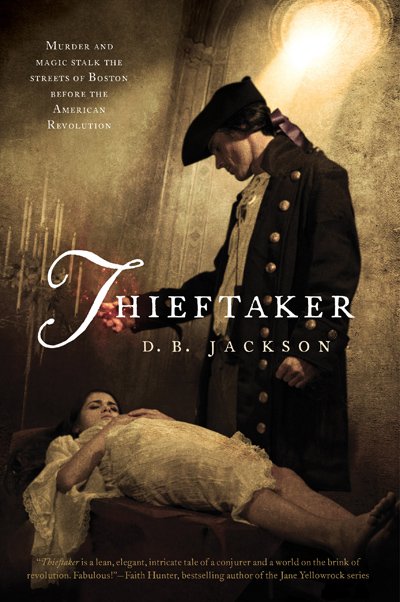
By way of example: THIEFTAKER begins on August 26, 1765, a night when a mob of protesters rioted in the streets of Boston to vent their frustration at Parliament’s passage of the Stamp Act.  (In the book, the riots coincide with a murder that Ethan has to investigate.  But I digress.)  The homes of several British officials were ransacked, most notably that of Thomas Hutchinson, the Lieutenant Governor of the Province of Massachusetts Bay.  Hutchinson blamed James Otis and Samuel Adams for much of what happened that night, viewing them, with some justification, as the leaders of the growing rebel movement.  But one name you almost never find in history textbooks is that of Ebenezer Mackintosh.  Great name, right?  You might think that a man with such a name would attract some historical attention, especially when you learn that he was the leader of the mob responsible for so much destruction and subsequent political upheaval.  But though as a co-called “street captain” he had a strong following among laborers and unskilled workers in Boston, he was never “important” enough in more formal political circles to draw the attention of scholars.  That said, he does play a crucial role in THIEFTAKER, as do Samuel Adams and Sheriff Greenleaf.

In addition to learning about some of the people who don’t usually find their way into “taught” history, I also learned a tremendous amount about the city of Boston itself, including the ways in which city officials sought to adjust to circumstances as population centers grew, making urban life more complicated.  During the middle decades of the eighteenth century, Boston experienced a number of devastating fires, not least among them the Great Cornhill Fire of March 20, 1760.  This fire began at a tavern called the Brazen Head and swept through the South End down to Boston Harbor, destroying three hundred forty-nine buildings and leaving more than a thousand people homeless.  Miraculously, no one was killed.  (I should note here that I have written a short story about this event — “The Tavern Fire” — which appeared in the AFTER HOURS: TALES FROM THE UR-BAR anthology edited by Joshua Palmatier and Patricia Bray.  The story can now be found at the D.B. Jackson website.

The spate of fires that struck Boston changed the cityscape.  After Boston’s Town House burned to the ground in the fire of 1711, the new one — the now famous Old State House — was rebuilt in brick.  In the aftermath of the 1760 fire, city leaders passed an ordinance mandating that all new construction in Boston be done in brick or stone rather than wood. Faneuil Hall, which was destroyed in the Cornhill fire, was rebuilt in 1761 in its present form, again in brick.  Moreover, noting that attempts to combat the blaze were hampered by lanes that were too winding and narrow, city officials also decreed that several of the smaller lanes in the Cornhill section of the city be widened and straightened.  As a result of the fires, Boston in 1765 looked far more like a modern city than it had only half a century before and by the end of that year, many of the landmarks we associate with Boston were already in place.

Finally, to bring this discussion full circle, I should add that in the aftermath of the Cornhill fire, one of Boston’s tax collectors refrained from demanding payment from those citizens most grievously affected by the catastrophe.  He had no permission from his superiors to do this, but he felt that those most in need should be relieved from having to pay.  His name?  Samuel Adams, of course.  As it turns out, Adams might have been a political genius, but his personal finances were a mess.  Several times, he almost lost his home at auction because of his personal debts.  And his poor relationship with money extended to his early public service.  In the early 1760s, a committee of the town meeting did an audit to determine why the city of Boston suddenly found itself in a financial crisis.  The audit determined that tax collectors had failed to bring in some four thousand pounds owed by the citizenry.  Adams alone was responsible for more than half of the shortfall.

These lesser known historical facts are more than entertaining.  They are tiny gems that make a historical narrative sparkle, that add depth and flavor and richness to a historical setting.  Getting the details right on things like the Stamp Act and even the riots that took place the night of August 26, 1765, was relatively easy.  Over the years, much has been written about those topics.  But the “untaught” history, the small details that are harder to find, are also the ones that catch readers by surprise, that draw them deeper into both character and story.  And, I have to admit, they are also the rewards of historical research that I value most.  After all, readers aren’t the only ones who need to be entertained; this should be fun for us writers, too.

*****
D.B. Jackson is also David B. Coe, the award-winning author of a dozen fantasy novels. His first book as D.B. Jackson, Thieftaker, volume I of the Thieftaker Chronicles, will be released by Tor Books on July 3. D.B. lives on the Cumberland Plateau with his wife and two teenaged daughters. They’re all smarter and prettier than he is, but they keep him around because he makes a mean vegetarian fajita. When he’s not writing he likes to hike, play guitar, and stalk the perfect image with his camera.

Maps (and miscellaneous)

1) Thank you to all who offered recommendations for light, humorous reading material. It is much appreciated. I’m going to get a selection of things and then see what sticks. Should be fun.

2) The winner of the copy of THE SHADOWED SUN by N.K. Jemisin was Kate P from the UK. Congrats!

3) There is a map of Europa in Cold Magic, and a map of North Amerike and the Antilles in Cold Fire. There may be a slightly more detailed map of Europa (or at least a part of it) in Cold Steel. Here’s your chance to request other map subjects, if indeed you have any. Is anyone interested in a map of the cities of Adurnam or Expedition?

I know that some love maps, some are indifferent, and some dislike them. That’s as it should be.

I personally like maps, because I’m geeky that way but also because I process information both visually and kinesthetically, and thus maps make it easier for me to negotiate certain kinds of plots. Yet with other stories, I don’t even think of wanting a map. I wonder if there is a kind of story that seems more to benefit by a map while others just don’t have any call for them.

There are narratives in which there are things about the world you can’t learn from the story but which you can glimpse if the book includes a map, so in that sense a map can add a bit of extra dimension to a world. One of the challenges of writing the Spiritwalker books in first person is that there is a lot of information about the world that can never get into the narrative because it isn’t something a) the narrator would reflect on much less know &/or b) that is necessary to the plot.

In world building as it happens on the page, I believe there is another way at looking at “mapping.” By this I don’t necessarily mean an actual drawn graphic map as a representation of a place, but a map of geography and society and history that is created in the mind of the reader as s/he walks through the story.

Secondary world stories (a term commonly used to describe stories that are set in worlds that are not this world) have to walk a fine balance. If you pile in too much detail, then it slows down the pace and drive of the story (I’m not immune to this writing flaw). However, if you put in too little detail, then the danger becomes that readers will mentally fall back to a “standard.” That is, they may read onto the world a kind of generic medieval-Europe (or British Victorian or whatever) setting regardless if that is the one there. If a story is set in a Europe-inspired setting, then this is not a problem. But if the story is not meant to be set in that landscape, the writer (I think) has to invest a little more detail and explanation to differentiate their world from the sort of world people so often expect to see in, say, fantasy novels. Of course, again, too much detail and the narrative bogs down. The endless cycle thereby continues: What to show? What to leave out?

How do you write or read through this balance?


I need book recommendations

Please recommend to me light, humorous mainstream novels appropriate for a broad-minded 85 year old man recovering (splendidly, but still . . . ) from surgery. Probably not Prachett or other sff-related genre humor as he is not an sff genre reader (although he has read all of my novels). But the humor can range afield from, say, the Kingsley Amis type “comic” novels or Wodehouse. IOW, something more recent and maybe not just from a white male academic perspective, if you see what I mean.


He just read a grim Icelandic WWII/Cold War thriller, and wants a break and something more hopeful and uplifting. Not cloying, though. Satirical is all right, but surely there recent mainstream comic novels out there that would please.


Thanks in advance.

Book sign/reading from Cold Steel in L.A. in July

I’ll post this twice more as the time grows closer, but I want to announce that I will be doing a book signing together with the wonderful fantasy writer Lynn Flewelling on

SATURDAY JULY 28 at 2:30 pm

at Mysterious Galaxy Redondo Beach (Los Angeles)

I will read from COLD STEEL. I might even let the audience vote on which of several short excerpts they want me to read from . . . Rory getting naked? Bee telling off powerful men? Cat punching, well, anything?

Also, I will have hard copy pamphlets of the bonus chapter 31.5 from COLD FIRE available (I’m not charging for them).

As always with this kind of signing, you can bring your books from home for me to sign, and that is perfectly fine, but it is also courteous (and useful!) to make a purchase (of some kind, not necessarily my books) from Mysterious Galaxy, the hosting indie bookstore, because they have to sell books to stay in business in order to host signings and readings like this one.

Also, if you cannot attend the signing, you can place an order beforehand and get a signed (and personalized, if you wish) copy of any of my books which they have in stock, which they will then ship to you afterward.

I would love to see you all there.

Just as an FYI: I plan to attend the Sirens Conference in mid October (near Portland, Oregon), and may do a signing at Powells at that time. I also plan to attend World Fantasy Convention in Toronto, Canada in early November.

Cultural Imperialism Bingo, Beta Readers, Writers and Depression: Links

I meant to do an entire blog post to boost the signal for The Western Cultural Imperialism Bingo Card but Family Stuff has intervened so I will instead link you to Aliette de Bodard’s blog where, if you so choose (and you haven’t already), you can read all about it.

I just want to make a brief comment. Because of time zones and my geographical position in the middle of the Pacific Ocean, I often frequent Twitter at hours when I’m more likely to engage with an international contingent than a USA contingent. Thus I inadvertently became involved in the bingo card development, although very much as a secondary player. I know some people don’t care for the bingo cards, and that’s cool. I don’t think it’s required that everyone like them or link to them or find them useful. I personally think they serve a useful purpose because I don’t see them as representing the entirety of people’s thinking on these complex matters; they’re just one of a number of tools that can be used to discuss or provoke or illuminate, but mostly I see them as a way to get past the usual conversation-stoppers and into potentially more nuanced and productive conversations. This is just my personal opinion; I’m not speaking for anyone else.


Donna M Hanson interviewed me as part of her series on using beta readers.

An excellent beta reader reads the story that is there and comments on how well it works. A poor beta reader reads the story and comments on the way they would want it written.


Writer Saladin Ahmed (I gave a quote for his debut novel Throne of the Crescent Moon) writes about depression and isolation. Sobering and honest.


Cold Steel: The printed out (unrevised) manuscript

Herewith a photo of the unrevised manuscript of Cold Steel. I printed it out because I received my editorial letter from my editor today . . . a mere ten pages. While I do revise on screen as well, I like to do an editing pass on paper; it just looks different and the visual change highlights things I might not notice on the computer.

I expect to take about six weeks to do revisions, including a tight line edit, but overall nothing substantial, just a lot of careful close-up work, some trimming, and clarification of various elements and some scenes that need to have a little more heft and clarity.

Pen for size comparison. That’s 690 pages, double spaced, 12 pt, Garamond (I prefer to compose in Garamond rather than Courier or Times Roman because I like the look of it better.)

N. K. Jemisin’s THE SHADOWED SUN: Giveaway

Through the unexpected generosity of my publisher, I have ended up with two copies of N.K. Jemisin’s THE SHADOWED SUN, second book in The Dreamblood duology.

That means I have to GIVE ONE AWAY.

The first volume, THE KILLING MOON, I described in this way (on the front cover of the USA trade paperback): “The world is so fully fleshed out that I could breathe its spices . . . Jemisin proves yet again that she is one of the most important new writers in fantasy today.”

As an experiment, I’m going to try a “write a review” giveaway.

The rules:

To enter, write a review of a book and post it on your blog, Live Journal, Facebook, tumblr, Goodreads, Amazon, Library Thing, or another such site. The review does not have to be long (I know that long reviews are time consuming to write, so a short one is okay as is a long one) but it can’t be just a starred rating. The content of the review doesn’t matter–that is, it doesn’t have to be positive although it CAN be positive 🙂 .

Then post a link to the review either here or on my live journal mirror. (Don’t link to an old review, please.)

I think and talk a lot about visibility and how visibility affects careers. So my preference would be that you review a book by a woman writer OR by a man writer who is not one of the usual bestsellers whose books are reviewed umpteen times. [I won’t name names.] But, any new review will count.

In today’s publishing world, I think the hardest thing for a writer is being invisible — unknown — not seen. Talking up books helps both readers and writers. So, write and post a review, and you have a chance to win a copy of this FABULOUS novel.

USA and International entries (I’m mailing from the USA) welcome. Draw will be random number from entries received.

Giveaway ends in one week, Sunday 11 June 9 pm HT (Hawaii Time).


Progress Report: 1 June 2012

It seems I live by the principle of my eyes being bigger than my stomach.

In online terms that means I either make great plans for getting offline so I can work incessantly, and then check Twitter every 15 minutes

OR

conversely, determine to institute a fabulous program of blogging every day in a manner witty, wise, informative, profound, or edgy. You know. Like people do, who do that. Those people evidently will never include me in their number.

1) I’m still waiting to get my editorial comments on COLD STEEL from my editor, but this should not be construed in any way except that she has a number of manuscripts on her desk and has to tackle them in order of priority of publication schedule. I expect to hear from her soon.

2) Comments from beta readers are coming in, and I’m quite pleased on the whole. There are a couple of scenes I need to expand on, toward the end, but I knew that so this just confirms what I knew, and that is always pleasant. The reason the scenes got scanted is because by the time I was pushing to the finish of the novel I was so exhausted from the 14 months of wrestling with it and the sheer number of false starts and detours and wrong ways I had to correct that I just wanted to get to The End and then worry about revisions later. So that’s what I did.

3) When I mentioned to one of my beta readers that I felt bad that my readers were going to have to wait so long and patiently before it was published, she pointed out that I also have to wait: To talk about it. And since there are some scenes, and lines, and details, and Stuff that I really love, be assured that (for those of you looking forward to Cold Steel) that I am SUFFERING RIGHT ALONG WITH YOU. Kind of.

4) Next week I have a guest post going up on Monday (June 4) at A Dribble of Ink on diversity. I hope you’ll pop over and join the discussion, if one gets going.

AND

I am doing a Reddit AMA (Ask Me Anything) on Thursday June 7 at 8 pm CST (Central Standard Time) which is, uh, omg, like 3 pm my time. You know, I need to figure that out. ANYWAY, if you feel so inclined, please pop over. I’ll announce it again on Twitter and Facebook and here on Wednesday. By the way, Elizabeth Bear is doing an AMA on Tuesday June 5 at 7 pm CST. Also, my sons are concerned that because it is Reddit, no one will ask me any questions, so prove them wrong!

AND

I also answered seven questions about beta readers for Donna Hanson’s blog series on beta readers/reading. I don’t have a date for that going up yet, however.

World Building: The Map Is Not The Territory

My stories usually are conceived in a flowering of an image in my head in which I imagine a character in a situation that has some inherent emotion or urgency or conflict that engages my passion to explore it further. Why and how my mind generates these images I do not know.

The seven volume Crown of Stars series grew from an image of a youth walking on a path that led over a ridge as a storm rushed in from the sea and, on the wings of that storm, his meeting with a woman in armor who is a supernatural manifestation. He is dissatisfied with his dreary, ordinary life, and the grim warrior woman seems to him to personify the life of adventure which he believes he yearns for, but the bargain she offers and which he accepts is not truly a gift nor is it a good bargain for him or indeed for anyone. The setting and situation made it clear it was to take place in a European-medieval type of environment. Literally, that is the genesis point of the series. In the published novel, this scene occurs in the third chapter of the first book (King’s Dragon).

Sometimes the initial image I have doesn’t make it into the book in the exact form I first encountered. My conception of what later became Cold Magic started with two girls, cousins, seated in a classroom overlooking an entry courtyard. Through the window, they see a carriage arrive conveying a man who will change their lives in some unspecified way. I kept the academy, the cousins, the man, and them watching his carriage arrive through a window, but changed the venue of the meeting to their home. In the initial image, I knew nothing about the man except that he was arrogant and from the upper rank of their society, and the only thing I knew about the young women was that they loved each other with true loyalty. Their dress and the building and carriage revealed the setting to be in some kind of 18th/19th century milieu.

That’s where the STORY starts.

Once I open myself up to building more on that image, that emotion, that interaction, I start the world building process.

The world building process, for me, hauls in tandem with the  accumulation of plot, character, and incident that develops into the story. The two processes interact with and feed each other. One doesn’t happen alone. I don’t build a world and then stick a story in it. I don’t come up with a plot and characters and then construct a world around them. The elements are completely intertwined such that I could not pull those characters and that plot out of one story and insert them into another, because characters and culture and thus their actions and reactions exist in a specific map.

In fact, it’s true: With world building, I always start with a map.

However, by that I don’t mean a map drawn on paper or in the computer. I don’t mean a physical, graphical map.

I mean I start by figuring out how the people in this made-up world perceive the cosmos and their place in it. There will almost certainly be more than one “people” in the world, and each “people” will have a unique way of understanding the cosmos and their relationship to their gods (if they have them), the natural environment, their culture, and to other people both within and outside their own culture.

I have to understand this “internal map” before I can proceed.

One way I do that is by asking questions, as I discuss in this post.

Another favorite technique of mine is to draw a geometric configuration that represents a way of looking at, understanding, unifying, or embodying a culture’s understanding of the cosmos. Many sacred buildings can be understood as physical embodiments of a culture’s understanding of the spiritual and sacred underpinnings of their world. So, for instance, I couldn’t move forward with writing Crown of Stars until I visualized the world and story. I ended up seeing them as two interlocking triangles. The three points of one triangle represented the spiritual and magical aspects of the world while the other triangle represented physical aspects of the world and story.

Because a visual structure appeals to the way my brain organizes information, I like sketching out a geometric representation, but that is just something that works for me. There are all kinds of ways to think about and relate to these concepts, nor is it necessary to think about them at all if that is not how the writer creates story. I mention this because I don’t want to imply that this is how one must or ought to proceed. I’m simply discussing how I personally create my worlds.

At the point at which I have a basic conception of the basic cosmology of the world (however artificially defined it may be), then I will usually draw a physical map of the terrain, the major landmarks, and population centers. Over the course of developing the story and writing the first draft, I will add to this graphical map.

But to paraphrase by quoting Alfred Korzybski, the physical map is not the territory in which the story takes place.

I don’t “start with a map” by placing mountains and rivers and cities on a piece of paper because physical landmarks offer only a partial understanding of a world. A physical map is by definition incomplete and circumscribed because it gives no insight into the mental and emotional and spiritual processes of the characters and the cultures in which those characters live their lives.

I’ve written about this kind of map-making here. The main point I want to draw from that post, in relation to this post, is how careful we have to be about the concept of a graphical representation—the physical map—as being objective. To quote Russell Kirkpatrick: “Maps are not value-free representations of the world.”

This is why the map I start with is the internalized map.

Every character in the story has an internal map through which they measure, comprehend, and navigate the world they live in. Their maps won’t be the same as every other character’s, and they won’t be the same as mine.

That is possibly the most important point.

To understand how “the peoples of my world” look at the world they “live in,” I have to move outside my own narrow range of experience. To a fair degree, I never can, but with conscious effort I can attempt to widen my view and shrink my limitations bit by bit and piece by piece. If I don’t think about the unconscious ways in which my understanding of the world is limited by my upbringing and its setting, and by my own cultural expectations and experiences and perceptions, then I will bring those unexamined assumptions into my world building (and I do indeed do this all too often despite my efforts not to).

I don’t write fantasy and science fiction only to be a mirror to my own experience of the world, even if my own experience strongly influences everything I write.

To quote myself, from the article referenced above:

If a place isn’t on YOUR map, the map in your mind of what matters about the world you want to write about, then you the writer can certainly not go to places you’ve never thought about, places you think don’t matter enough to warrant notice. Matters that aren’t visible to you.
I believe that it is crucial to pause and reflect on what may be invisible in your own personal map as well as the map you are creating.

So, yes, early on in the process I will draw a cartographical representation of the physical world. Yet for me, the most important “map” is bigger than that. It’s not flat, it’s multi-dimensional: A physical map intersects with this internal map, and these conjoined maps influence and are influenced by the architecture of the narrative as it unfolds. I cannot separate these three things as I write.

Guest Post: LOOKING FOR THE WOMEN (IN ANCIENT ROME)

Recently there’s been a great deal of discussion on the topic of whether women did actually exist in “historical times,” by which I mean to say that all too often “common knowledge” of what women’s roles were in historical periods is a mythology. If writers and readers base their expectations of women in fantasy fiction on these erroneous stereotypes, then not only is our literature and our reading the poorer for it but it is also getting it wrong.

Today I offer a guest post by Australian writer Tansy Rayner Roberts on this very (and very important) subject.


Looking for the Women (in Ancient Rome)

by Tansy Rayner Roberts


I was inspired to write this after Kate’s post about looking for women in historically-based fantasy worlds.

It’s long frustrated me that a great deal of fantasy fiction in the long tradition of the genre underestimates women.  In particular, I am tired of worlds which are supposedly ‘based on medieval history’ and yet seem to be under the impression that women in the Middle Ages only turned up when a hero needed someone to marry, or to pour him a drink.

And I’m especially, especially tired of any attempts to interrogate the gender politics in fantasy fiction being shut down with the argument: it’s based on real history, so the sexism is AUTHENTIC.

I’m not going to lie to you.  Every historical period has been unkind to women, up to and including our own.  But that doesn’t mean that there weren’t complex and interesting possibilities available to women of all eras, in between stirring the turnip soup and being oppressed.

My favourite fantasy fiction is fed by history, by the nitty gritty details of things that really happened, people who had real lives, tossed around with magic because that automatically makes things more fun.

I wanted to bring my knowledge of Ancient Rome to what Kate has already talked about, largely because I think we can all take a rest from pure Anglo medieval-inspired fantasy for a decade or two, but also because Rome is what I know best.

Ancient Rome is packed with the types of historical issues we see people running up against when trying to write non-sexist stories set in mostly-sexist societies.  In Rome, there was a very clear division between the public and private spheres.  Sadly almost every historical document that survived to document their society was kept because it related to the ‘obviously important’ public sphere in which men were dominant.  Most of the sources we have about private life are conveyed in the words of men, such as the Letters of the Younger Pliny.

But while women had no technical power in that public sphere (which mostly consisted of military issues, senatorial politics and toga parties) they had immense power behind the scenes.  They had their own religious rituals which were considered just as important to the well being of the state as the public, mostly-male rites.  For a long time, scholars assumed women’s religion was less important because they weren’t allowed to make blood sacrifice, and it’s only recently that scholars have gone, um, maybe we only assumed blood sacrifice was more important than, say, baking the sacrificial cakes, because the men were in charge of it?  Oops.

Women of all social levels ran businesses, owned property and slaves, and moved freely around their local city or, if they preferred, the Empire itself.  Even aristocratic women could do those things, though they were more likely to have male relatives who wanted to control them.  The older a woman got, the greater her status.  Divorce was easy to achieve (as long as you weren’t too emotionally attached to your children, one hell of a loophole) but there was special social status granted to a univira, the rare woman who had only had one husband in her lifetime.

We know that Augustus, the first emperor, brought in legislation to try to control women, a little under two thousand years ago, and that tells us a lot about how unruly they had become!  In particular, he brought in a law to force women of the upper classes to remarry within two years of being widowed (and one year of divorce).  This was somewhat devastating, as divorcing your husband or becoming a widow had previously been the best way for  a woman to achieve independence.

Still, we have some great examples of interesting women in Roman history, who had rich and fulfilling and complex lives, despite the patriarchal society in which they lived.  Such as:

THE VIRAGO
The word ‘virago’ was supposedly coined by Octavian (later the emperor Augustus) to insult his rival Marc Antony’s wife Fulvia.  It means ‘women who acts like a man’ and referred to the fact that Fulvia joined her husband on military expeditions.  She wasn’t actually wielding a sword or wearing armour (not that I’d put it past her, she was a feisty lady), but it was apparently unusual for a woman to prefer to rough it in a tent with her husband rather than stay home in comfort with her children.

Having said that, we know of several other women who did the same thing, including Agrippina Major (the granddaughter of Augustus) who raised her children in military camps so they could be near her their father (and so they would all be far from the dangerous politics of the capital).  Later, the Empress Faustina Minor discovered that following her husband to war allowed historians to trash talk her reputation (though the accusations that she had affairs with gladiators had little to do with her own reputation and everything to do with how much the Romans hated her son, the Emperor Commodus).

THE VIRGINS
While having a husband was the key to many social successes and honours in Ancient Rome, it was not always compulsory.  The Vestal Virgins were the among the highest status women in the city.  While there were some scary stories circulating about what would happen to a Vestal if she broke the chastity rule (buried alive for a start) they were nevertheless trusted to regulate that chastity themselves.  They were not shut away or guarded by eunuchs as some 1960’s movies might have you believe!

In fact they moved through the city in freedom and comfort, attended dinner parties, performed rituals, and took part in several business-related duties including the receiving, archiving and dispensing of the city’s legal wills and other documents.  They often had political influence, and had the same status in a law court as a man – which is to say their word had greater legal weight than any other woman of the time.
After thirty years of service (they sign up as children) each Vestal would be released with a generous dowry, and could either live independently or choose to marry.

THE MISTRESS
One of my favourite historical characters (only partly because of the marvellous historical novel written about her, The Course of Honour by Lindsey Davis) is Caenis, the mistress to the Emperor Vespasian (he who built the Colosseum).  Caenis’ story is fascinating because it goes against everything we think we know about Roman society and their class system, and what women were allowed to do.

Caenis began as an imperial slave, serving Antonia (niece of the Emperor Augustus, mother of the Emperor Tiberius) as a personal secretary.  She appears to have had an eidetic memory, and served her mistress dutifully through a time of great political scandal.  When she was freed, she took the name ‘Antonia’ as was tradition.

But while freedwomen could run businesses and own property, one thing not allowed to Antonia Caenis was to marry above her station.  Her love affair with the ageing general Vespasian thus was unlikely to be officially sanctioned by the state, but the class divide broadened when he became the surprise Emperor of a new dynasty.  Luckily he already had two adult sons.  He and Caenis lived happily together in the imperial quarters, she providing him with great advice and wisdom, until her death.

Even in a world where the rules of marriage and social status were quite complex and technically restrictive, love and smarts could beat them all into the ground!
There are so many other specific women I could have talked about – the further they got from the city of Rome itself, and the lawmakers who thought it was okay to dictate what women should do, the more likely they were to take all kinds of freedoms for themselves that the law didn’t actually allow for.  Take mixed bathing – the public baths were supposed to have separate areas for men and women, but half the time they all jumped in together, with all the social ramifications that might imply, regardless of whether or not the current Emperor though it was a good idea.  In smaller towns we even have women running local councils, or breaking with all manner of traditions expected of ‘good’ Roman matrons.

Then there’s the time that the Emperor Augustus gave a lecture about what men should demand of their wives, with all the senators laughing up their sleeves because they all knew that the women of his family had other opinions on the matter.

If we learn nothing else from Roman history, it is that there have always been strong-willed women who get their own way, no matter what the law or the ideals of the society say about it.  Personality can rule over technicalities, and even a sexist society can produce some amazing, capable women, those who work with the system as well as those who work against it.

Too often, female characters only get celebrated in fantasy fiction if they are behaving like men, or taking on traditional male attributes – the kickass lady in armour, the sorceress who can zap you if you say the wrong thing, and so on.  But while I’m all for putting women in (sensible) armour and throwing them out on the battlefield, I also would like to see greater use of other female roles in fantasy – of women’s brains, in particular.  The further back you go in history, the smarter women had to be in order to exhibit and use the power they had.  So let’s see more of THAT in fantasy.

If a story starts with a maiden, let’s not assume that she has to get locked in a tower.  There are alternatives…


This post was written by Tansy Rayner Roberts for her Flappers with Swords Blog Tour.

Tansy’s award-winning Creature Court trilogy: Power and Majesty, The Shattered City and Reign of Beasts, featuring flappers with swords, shape changers, half-naked men and bloodthirsty court politics, have been released worldwide on the Kindle, and should be available soon across other e-book platforms.  If you prefer your books solid and papery, they can also be found in all good Australian and New Zealand bookshops.

You can also check out Tansy’s work through the Hugo-nominated crunchy feminist science fiction podcast Galactic Suburbia, Tansy’s short story collection Love and Romanpunk (Twelfth Planet Press).  You can find her on the internet at her blog, or on Twitter as @tansyrr.