17 Author Book Giveaway (including Cold Magic)

This is an awesome giveaway: Sixteen authors of novels historical, fantastical, and adventurous have combined (the winner gets all 17 novels).

Look at these gorgeous book covers!

Look at these fabulous novels!

THE LANTERN by Deborah Lawrenson
NY Times bestseller modern gothic novel of love, secrets, and murder—set against the lush backdrop of Provence
THE FIREBIRD (ARC) by Susanna Kearsley
A twin-stranded story that blends modern romance with 18th-century Jacobite intrigue, traveling from Scotland to Russia, from the NY Times bestselling author of The Winter Sea
THE TWELFTH ENCHANTMENT by David Liss
In Regency England, at the dawn of the industrial era, magic and technology clash and the fate of the nation rests in the hands of a penniless young woman
COLD MAGIC by Kate Elliott
An epic adventure fantasy with a decidedly steampunk edge where magic – and the power of the Cold Mages – hold sway
THE MAPMAKER’S WAR by Ronlyn Domingue
A mesmerizing, utterly original adventure about love and loss and the redemptive power of the human spirit–releases March 5th!
DRACULA IN LOVE by Karen Essex
“If you read only one more vampire novel, let it be this one!” -C.W. Gortner, author of The Last Queen & The Confessions of Catherine de Medici
RED, WHITE AND BLOOD by Chris Farnsworth
High-octane supernatural thriller, a sequel to The President’s Vampire
THE HOUSE OF VELVET AND GLASS by Katherine Howe
The House of Velvet and Glass weaves together meticulous period detail, intoxicating romance, and a final shocking twist in a breathtaking novel that will thrill readers
from the author of bestseller The Physick Book of Deliverance Dane
THE FAIREST OF THEM ALL (ARC) by Carolyn Turgeon
The Fairest of Them All is an inventive, magical fairy-tale mash-up about Rapunzel growing up to be Snow White’s stepmother, out in August 2013 from the author of Godmother and Mermaid
THE BOOK OF LOST FRAGRANCES by M.J. Rose
A sweeping and suspenseful tale of secrets, intrigue, and lovers separated by time, all connected through the mystical qualities of a perfume created in the days of Cleopatra–and lost for 2,000 years by bestselling novelist M.J. Rose
THIEFTAKER by DB Jackson
Combining elements of traditional fantasy, urban fantasy, mystery and historical fiction, Thieftaker will appeal to readers who enjoy intelligent fantasy and history with an attitude
GLAMOUR IN GLASS by Mary Robinette Kowal
Glamour in Glass follows the lives of the main characters from Shades of Milk and Honey, a loving tribute to the works of Jane Austen in a world where magic is an everyday occurrence
DEVIL’S GATE by FJ Lennon
Devil’s Gate is exhilarating urban fantasy, with first class writing and characters that are unforgettable beyond the last page
THE CROOKED BRANCH by Jeanine Cummins
“Wonderfully written, with strong, compelling characters, it is a deeply satisfying combination of sweeping historical saga and modern family drama, a gentle reminder of the ever-reaching influence of family”–Booklist
A NATURAL HISTORY OF DRAGONS by Marie Brennan
The story of Isabella, Lady Trent, the world’s preeminent dragon naturalist, and her thrilling expedition to Vystrana, where she made the first of many historic discoveries that would change the world forever
THE RECKONING by Alma Katsu
In the tradition of early Anne Rice, a gorgeously written sequel to The Taker that takes readers on a harrowing, passion-fueled chase that transcends the boundaries of time.

***

The contest runs from March 1 – 15 and winner(s) will be notified within 48 hours. We’ll give away one set of books per 500 entries.

Enter by using the form below. Please note that this contest is open to residents of the US, Canada and the UK only and by entering, you agree to be added to the authors’ mailing lists (don’t worry; you can always unsubscribe from any mailing list at any time).
a Rafflecopter giveaway

Questions Fill In For Answers (Spiritwalker Monday 17) Mostly News

I am hopelessly behind on writing up the Creole Part II post (for those awaiting it), much less other Spiritwalker related posts I have titled or partially sketched out like the one discussing how The Taming of the Shrew influenced the series, or the one about Place Names in Europa and how most of them aren’t made up, or the one about the greetings in Cold Magic (& how they’re not my invention), or the one discussing some of the choices I made in Cold Fire regarding Cat’s behavior as a post titled “Cat Alone.” Also additional posts I have partially written on subjects such as world building and writing and so on.

The main reason I haven’t gotten any of these posts finished is that I’ve been working to complete a first draft of a YA (Young Adult) fantasy which I’m writing for my own reasons, to see how it goes and if I can manage it. Which I have now done: A first draft of  of volume one comes in at 125,000 words (that’s like a novella when you average 175,000 – 200,000 words per volume!) and I am revising it to send to my agent. Then we shall see. It is set in a secondary world and is not really based on anything else but as a pitch line I’m calling it Little Women meets Count of Monte Cristo in a world inspired by Greco-Roman Egypt.


Other news:

I have a story in a forthcoming anthology of epic fantasy themed short stories, Fearsome Journeys (edited by Jonathan Strahan) to be published May 2013.

Here’s the table of contents:

  • “The Effigy Engine: A Tale of the Red Hats” by Scott Lynch
  • “Amethyst, Shadow, and Light” by Saladin Ahmed
  • “Camp Follower” by Trudi Canavan
  • “The Dragonslayer of Merebarton” by K.J. Parker
  • “Leaf and Branch and Grass and Vine” by Kate Elliott
  • “Spirits of Salt: A Tale of the Coral Sword” by Jeffrey Ford
  • “Forever People” by Robert V.S. Redick
  • “Sponda the Suet Girl and the Secret of the French Pearl” by Ellen Klages
  • “Shaggy Dog Bridge: A Black Company Story” by Glen Cook
  • “The Ghost Makers” by Elizabeth Bear
  • “One Last, Great Adventure” by Ellen Kushner & Ysabeau Wilce
  • “The High King Dreaming” by Daniel Abraham


In the UK, as I have already mentioned, all seven of the Crown of Stars volumes are now available as e-books. The first three are available as e-book editions in the USA (no timetable for volumes 4 – 7 that I have been told). I’m not sure about Australia/NZ (if you have been able to purchase an ebook of one of the Crown of Stars volumes in Australia or NZ, please let me know).


I hope to be able to have some good news to report soon regarding e-book versions of the Novels of the Jaran as well as the Highroad Trilogy and The Labyrinth Gate.


Cold Steel is still scheduled for June 25, 2013 . . . . slowly getting closer.


Since I have not managed much value-added in my post, if you have a question to ask me about any of my books, about writing or any related subject, or about something else, feel free to do so here. And I will answer.

The Shame of Self Aggrandizement (Spiritwalker Monday 18)

In a post dated January 2012 that consisted of an update and several links to reviews of Cold Magic and Cold Fire (here on WordPress and mirrored on Live Journal):
I wrote:

There’s a part of me that feels it is wrong for me to link to positive mentions of my work like the ones above, as if I am thereby somehow self aggrandizing or bragging or trying to act like I’m better than others or something. This is some of the baggage I carry from growing up as a girl in the 60s and 70s. I’m not quite sure from whence it stems, and I can certainly only speak to my own experience. Partly, it seemed to me that girls were meant to do well but never excel more than boys and certainly if they did excel weren’t ever to say anything of it because it was unseemly and boastful and something one ought to be ashamed of. In fact, there is a little piece of my psyche that feels ashamed (yes: ashamed!) when I read a [really positive and praising] review.


In the comments on Live Journal, lostrack621 wrote this in reply:

You nailed it right on the head; but I would go as far as to say that it’s not just related to the time you were growing up. I feel the same way, too, and I’m an ’80s child. I’m a member of the Association for Women in Science and there was an article recently about how one of the big issues and problems with women in science today (and arguably other fields) is that we are taught that bragging and taking ownership and simply being darn proud of our work is somehow “bad” and frowned upon. Part of it probably comes from the ’50s and ’60s, but the big issue is WHY is this belief persisting and what can be done to stop it. Every month there’s a new blurb about how to become more productive, well-known, etc etc because for some reason, we women are STILL behind the men. I mean, JEEZE LOUISE, we do these amazing things and there is no reason to feel bad about tooting our horns about it but for some crazy reason we do. So, I don’t know how we – collectively as amazing women – can break down these barriers other than doing what we’re best at and keep doing what we know is working for us. :: shrug :: I’ve come to the point where I just keep my head down and slog through (speaking of, I should get back to my work….)


First of all, I don’t want to suggest that ONLY women get this message because I know of men who get it, or who feel it, also.

“Simply being proud of our own work:” Amazing how contentious that can be. How difficult to own, as if it is shameful to say “I love this project” or “I really nailed this.” That can expand to discussing one’s own work in appropriate contexts, as if one ought to just produce the work and then never mention it again because that would be immodest or self aggrandizing. [I am not talking about situations where people push their project, work, or title into every conversation, but note that I feel obliged to make that caveat, as if I am sure that even by discussing this someone out there will be thinking that I am saying too much or that they once sat on a panel with a person whose every answer/statement was a reference to his/her own book, as if that is equivalent, related, the inevitable end of any mention substantive or brief of one’s own work.]

What is this? How many of you feel it? Where does the pressure come from?

I have felt undercut at odd times from unexpected places, and I often wonder if “we” even know we are doing it, if we judge praise or discussion of praise more harshly and if there is a gender–or race or ethnicity–component in how we do so. Is there praise that is never questioned and success that is deemed always “appropriate?” While other success is always suspect?

How about your own personal experience? Do you, like lostrack621, feel that “taking ownership” is frowned on in your field, for you? For others?


Strength (Spiritwalker Monday 19)

There are a lot of ways to write about strength.

As a writer I can get frustrated when a characteristic I mean to be understood as strong is interpreted by a reader as weak, even though I comprehend that every reader will bring a different interpretation to the table. Also, and more importantly, I get frustrated when I see myself as a writer falling into the trap of stereotyping “strength” and “weakness” in ways I don’t like and which I think are negative but which I revert to if I don’t stop and think past received assumptions about people and gender.

What do we mean when we say “a strong male character” or “a strong female character”?

What about “a strong character?” How does that come into play without it being tied to gender or sex?

And what do I mean by “we,” anyway? What about cultural and historical differences in how strength is defined?

What is strength?

There are so many ways to define strength in terms of the human personality and human characteristics and how it relates to what is valued in any given society at a particular moment in that society’s development or decline. What defines strength now may in twenty years or a thousand years be seen as a sign of potential weakness, while something I define as weak may be seen as strong elsewhere.

Actual physical feats of strength range from a simple measure like weight-lifting to a more complex measure like physical endurance. As a woman I have been told more times than I care to count that men will always rule human civilization because they are physically stronger by what I call the weight-lifting measure, an opinion that oddly leaves out humanity’s crucially advantageous traits of dexterity, adaptability, creativity, intelligence, and persistence. And what about endurance? In some ways, endurance is the greatest test of strength.

Is strength a way to tear things down or to build things up? In the Bible, Samson famously does both, although it is important that while his strength is commonly defined as physical in fact, as a Nazirite, it is his spiritual strength that has nurtured his physical strength.

Sometimes it seems like portrayals of strength in the (heavily USA-based) media I see around me are getting choked through narrowing definitions. I say that in part because I think mainstream US media is going through one of its cyclical restricting modes, while meanwhile in the global gestalt a new creative energy and vision is expanding with increasing vigor.

Part of that is because views about strength, like views about anything, go through fashions: the strong silent cowboy becomes the blustering self absorbed Rambo; the man too honest and righteous to break the law becomes the man who breaks the law to make things right; the calm moderate in-control man becomes the angry passionate man while meanwhile in many societies being unable to contain or control anger is seen as a flaw rather than as a sign of strength.

During the writing of Cold Steel I had a series of email exchanges with Michelle Sagara about definitions of and assumptions about masculinity in our culture.

I was concerned that a particular character might not be seen by some readers as a “strong male character” because he does not display several of what are typically (although not exclusively) seen in today’s media/fiction as “strong male” characteristics. This isn’t an exclusive or finite list, but two of the characteristics I identify as seeming to me to be stereotypical today as approved markers of masculinity are the “man as soldier” (or warrior) which is related to but not exactly the same as the man who uses violence (and kills) to righteously solve problems. I still also see elements of a type I call “the masterful man,” the man who won’t take no for an answer, who knows what he wants perhaps better than you do, who pushes until he gets what he wants. This is a form of what is often called “the alpha male” but by no means the only example of the type. All three of these types seem to me important in an imperial context: That is, an empire tells stories about itself to justify the empire, and some of those stories naturally will include valorizing war and soldiering, violence, knowing better than others, and the idea of exceptionalism, that the empire is destined to rule and/or somehow favored by god, chance, Fate, or destiny.

Leave aside for the moment the larger and related question of what exactly we mean when we say male, female, man, woman, and so on ( I’m no gender essentialist regardless). And for the moment I’m speaking about my experience primarily but not exclusively with American English-language media and fiction.

If strength is defined in limited ways, then human character is not only limited but harmed by being forced to adhere to increasingly smaller sets of perceived value. When certain characteristics got locked in as strong and others ignored, or derided as weak, it creates a restrictive view of humanity.

Crucially, for writers, narrow definitions of what constitutes a strong man or a strong woman can affect how people read and view those characters. Some readers will reject a character as strong because that character does not adhere to stereotypes of “strong.”

For instance strength can be expressed through patience, and patience is a characteristic that both men and women have. But if patience is not seen as a masculine characteristic, then a male character in a fictional story characterized as patient may or may not be seen as a strong man. For example, the film Witness contrasts Harrison Ford’s world weary and violent cop with Alexander Gudonov’s non-violent, patient, quiet Amish farmer (it finds both men ultimately positive as role models but I note that the story revolves around Ford’s cop).

If male characters can’t be seen as strong except when martial or angry or violent or masterful in the sense of being forceful, then think how harmful that becomes to our understanding of what it means to be a man and the cultural creation of role models for boys to grow into. Think of how harmful it is for women.

And what about women? What is a strong woman? One who kicks ass and can fight “as well as a man”?

As many have pointed out before me, if women only get to be strong insofar as they look and behave like men, then that does not uplift women.

If characteristics long defined as “feminine” are automatically derided as “weak” or undervalued and dismissed as “girly,” then those attitudes affect all children as they grow into adulthood just as restrictive attitudes about boys affect all children likewise.

I love stories and characters that celebrate diverse ways to be strong.

In Grace Lin’s Where the Mountains Meet the Moon, Minli is stubborn and determined. And she listens.

Oree, in N. K. Jemisin’s The Broken Kingdoms, has a clear and powerful sense of herself that makes her strong.

In Michelle Sagara’s Silence, the main character Emma is caring and loyal to her friends and to others. I tend to find compassion a sign of strength, and it appeals greatly to me in characters.

In Cold Fire, I deliberately had Andevai court Cat not with manly arrogant alpha-ness but with patience and food.

While Nevyn in Katharine Kerr’s Deverry sequence does fit the acceptable mode of the “mysterious and wise old man with magical powers” character, he himself is strong because he uses his mind, is often kind and patient, and because he fulfills a very long burden of service to make up for a wrong he caused. That’s strength.

The sisters in Aliette de Bodard’s story “Immersion” are strong by being smart, observant, thoughtful, and (again) determined. Their radicalism is quiet, necessary, in some ways tentative, and within its small orbit it is effective.

Strong female characters in Danish tv shows like Forbrydelsen, Matador, and The Eagle work well for me because they are portrayed as competent, intelligent, no-nonsense, pragmatic, efficient, compassionate, caring, and steadfast.

Of course every reader brings their own view of strength to the table.

What portrayals of strength (from any fiction) have you liked that did not fit with classically stereotypical kickass or martial or alpha-manly definitions of strength? Do you think that SFF and YA, for example, are pushing the boundaries of what is seen as strong or are more likely to fall back into more standard modes of “strength expression”? Are all characters given equal chance to be seen as strong, or are some given more limited roles than others?

I have no definitive answers. I’m just asking questions here.

Apex Magazine story, Crown of Stars retrospective, & Crown of Stars ebooks

The February 2013 Apex Magazine is out with a Shakespeare theme.

I have a story (“My Voice is in My Sword”) and am interviewed in the issue, which you can find here.

Again, here is the link to a retrospective I wrote, looking back on the Crown of Stars series, which you can find at the Orbit Books web site.

All seven of the Crown of Stars books are now available in ebook form, from Orbit UK in the UK region.

The first three volumes of Crown of Stars are available in ebook form in the USA and other English-language venues. No schedule yet for the ebook publications of #4 – 7, although they are all available in print form.

Reviews, Word of Mouth, Conversation, & Community (Spiritwalker Monday 20)

Where and how do you discover the books you read and media you watch/consume? How much does word of mouth or reviews play a part as compared to research or relying on past experience?

Do you write reviews? And if you do, what audience do you hope to reach?

Do you read reviews? How do you interact with them?

The process of reviewing (as opposed to the critical essay) has had such an explosion because of the internet that both as a reader who reads and as a writer who gets reviewed I’m fascinated by the process of liking what others like, disliking what others dislike, liking what others dislike, disliking what others like, and the worst reviews of all, those of indifference and of the judgment that a work is trivial, unimportant, and ignorable.

There are many platforms where reviewers are clearly reviewing for other readers, for each other, an ongoing conversation about books both in the largest sense of the reading gestalt (what is fashionable, obscure, elided, needed, and trendy or out of fashion at any given time) and of course of individual titles that a person may want to excoriate or praise.

But I also just heard a story about a writer who was emailed directly by a person who wanted to make sure to tell the writer about how much they (the reader) had disliked the work of that writer which they had read. What is up with that? That so puzzles me–not the disliking because people will not all like (or dislike) the same things, but this odd need to inform the writer so as to . . . to what? What does it accomplish? How does it relate back to the larger sense of conversation? How is this part of a productive conversation?

But just as some reviewers are clearly writing to engage primarily or only with other reviewers and readers, others do seem to want to engage — whether positively or negatively — with the writers. There are so many layers and complexities involved.

I don’t review books but I do like to talk about books I enjoyed. I’m more likely to review film/tv, I suspect because I am not part of that community. At the same time, I have no problem whatsoever with writers who do review; more power to them.

Do you feel like you are part of a larger ongoing discussion of books/media that takes place online (and to a lesser degree off line)? Perhaps that is a question already answered by the fact that you are reading this on a writer’s blog. I feel I am often submerged in this ocean of book discussion, as a participant fishing in from several angles, both the reader and the read.

I have to make decisions about how I am going to interact with reviews of my own work (whether to read or not read, and how or whether to internalize the reactions of readers which can be so diverse), how I approach books/media I’m reading and how much I want to say/converse about them, and how much I engage with reviewers and reviews in general even just as a reader. Like anyone, my opinion may be swayed or my interest piqued in all kinds of ways, some positive and some negative.

Everyone makes these decisions from one day or one month or one year to the next. It is difficult, I think, to say that one works or even reads in true isolation, not now.

Cold Steel, Crown of Stars News, & A Reprise: Five Ways of Seeing Andevai (Spiritwalker Monday 21)

Page proofs of COLD STEEL are complete and turned in.

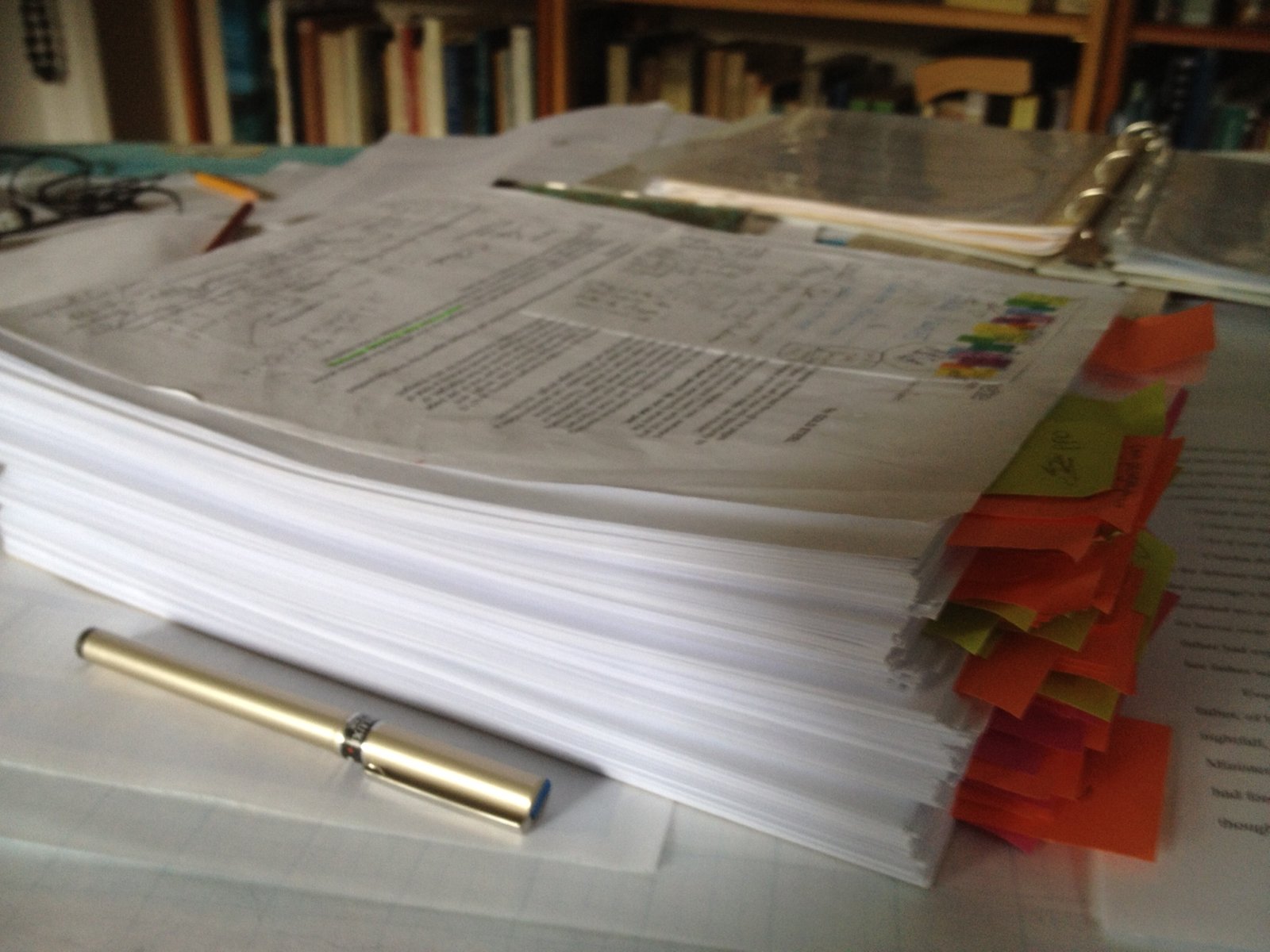
The over-abundance of orange post-its has to do with a typesetting glitch (which I have been given to understand is already corrected).

This officially is the cleanest set of page proofs I’ve ever gone over. In a 597 page manuscript I personally found only four mistakes (the official proofreader called attention to a couple of other things for a total of perhaps 8 mistakes). The rest are small changes I made because I cannot stop niggling with the manuscript. Substituting one noun because I had repeated a different noun four times. Replacing a slightly clunky line of dialogue with a sharper snarkier one. And so on.

BUT IT IS NOW DONE. In other words, I can’t change anything else even if I wanted to.

Meanwhile, sometime later this week Orbit UK will be announcing the release of all seven of the Crown of Stars books in digital editions. They asked me to write up a Crown of Stars Retrospective post (in whatever manner I wanted to retrospect the series), and composing that short essay took all my post-writing time for the week. So I still have not completed the second part of the post on the Creole of Expedition (Part One here). In fact, I have no Monday post ready to go at all, and thus because I determined to post every Monday like I promised, I decided here today to reprise a post from May 2011 in which I group the most common reactions to Andevai as he appears in Cold Magic into five basic descriptions. I did this because reactions were very divided, and also because I knew once Cold Fire came out, I would likely get a new set of reactions.

Here they are, five ways of seeing Andevai (behind a cut so those who remember the post can, if they wish, skip it): Continue reading

Short Stories, Deadlines, & the Cold Steel FINAL Cover (Spiritwalker Monday 22)

This week’s Spiritwalker Monday post was supposed to be The Creole of Expedition Part Two (Part One from last week can be found here), in which I go into detail (and quote extensively from people who know more than I do) about how I “created” a creole specifically for the city of Expedition so the people who live there could have a regionally specific way of talking.

I haven’t had time to finish writing that post because of other deadlines.

1) I am still working my way through the page proofs of COLD STEEL.

Of course I am looking for typos and grammatical mistakes, of which so far I believe I have found only two in quite a long manuscript, which means the Editor, Associate Editor, copy editor, and Sr Production Director have all done an excellent job. There is one odd glitch (marked by the orange post-its) which has to be trimmed out throughout [number strings that got dropped into/left in from some previous cycle of production]. Given the paucity of actual typos, my focus has been making any last (minor) changes such as changing a word or rephrasing a conversation or (in one case) adding a small revelation to the end of a chapter. This massive project is due at the end of the week.

2) A final copy-edit read-through of my short story “My Voice Is In My Sword,” which was originally published in WEIRD TALES FROM SHAKESPEARE (edited by Katharine Kerr & Martin H. Greenberg, 1994) and is being reprinted (together with a new interview) in APEX MAGAZINE‘s February 2013 issue. It’s now done and turned in.

3) Edits on my short story (technically a novelette) for Jonathan Strahan’s FEARSOME JOURNEYS (Solaris/S&S Summer 2013), a collection of original epic fantasy short stories. Due at the end of this week also.

Because of these deadlines, I plan to finish and post the Creole Part Two post — next week.

For this week, have a jpeg of the final cover for COLD STEEL. Note the cut on her cheek.

ETA:

I’ve edited the image below out and asking you to go to the image here (Cold Steel Final Cover).