The Omniscient Breasts

After years of thinking about this issue, and inspired by a comment on Twitter about omniscient breasts, I have finally written a post on the male gaze, the female gaze, and sexualized women in fantasy and science fiction novels.

Imagine a female pov character is going along about her protagonist adventure, seeing things from her perspective of the world as written in third person. She hears, sees, considers, and makes decisions and reacts based on her view of the world and what she is aware of and encounters. Abruptly, a description is dropped into the text of her secondary sexual characteristics usually in the form of soft-focus Playboy-Magazine-style sexualized kitten-bunny-I-would-fuck-her-in-a-heartbeat lustrous-eyes-and-nipples phrases. Her breasts have just become omniscient breasts.

You can read the whole thing over on my Buttondown newsletter (always free).

Teaching Ways to Revise: Necessary Words

In my experience both as a writer and as a writer who reads, the writer has a story in their head that is quite vivid. A less experienced writer often does not yet have the tools to fully bring the story fully to life on the page, to express and translate all the vivid emotion and imagery and idea so that another person can experience some measure of what the writer feels for the story.

So, two things:


Thing One:

I reckon the reader will never read exactly the story the writer has in mind because the reader brings their own experiences, thoughts, and reactions to the material. In other words, I maintain that it is impossible for any reader to read exactly the book the writer is doing their best to tell. That’s a topic for another post.

Why I make the point is to remind writers that their goal is to bring the story, the ideas, the emotions (whatever element matters most to the writer) to the reader in the strongest way possible, in a way that to the best of their ability and the limits of language makes a connection between the text and the reader.

Techniques that help create and strengthen that bridge between the writer’s construct which lives in the head of the writer and the reader’s interaction with the story are an important aspect of writing craft.

Thing Two:

Most often the biggest problem I see with manuscripts is that the writer has an interesting story to tell but the word choice, pacing, and deployment of plot and details hamper the story. They get in the way of the story rather than bringing the story into focus.

In my opinion, revision is the hardest part of the process to learn and to teach.

The process of learning to find the right words in the right order is so complex that, yes, I still struggle with it all the time. I am, I hope, still getting more proficient, getting better, learning from my mistakes — because I still make mistakes. Every novel I’ve published so far has mistakes in it that I haven’t been able to recognize until after it has been published and sometimes not for several years when I have left it far enough behind that I can finally get a decent sense of perspective about it.

A Way To Revise: Thinking About Necessary Words

The key to an effective scene is to use the words you need, in the order you need them in. This is a truism that is far easier to say than to do.

Probably your early draft uses words you don’t need, or lacks some words you do need. The more words you use which you don’t need, the more those unneeded words diffuse the intensity of the experience of the words and story. Additionally, in some places it may be the story could use intensifiers to highlight and clarify the emotion and emotion. That lack at certain crucial spots makes it harder for the reader to connect.

So how do you figure out which words you need and which are unnecessary?

There are many strategies for doing this. Mine is AN answer, not THE answer.

Let me repeat that. This is a way to think about revising. It is not the only way, the best way, or anything except one possible way out of many.

Here are some ways to think about the words.

1.    What is this scene about? What does the scene do both as a discrete scene and in the context of the entire story? If necessary, you can outline a scene or do a bullet points breakdown of what must be in the scene in order for the scene to have the impact you want it to have.
2.    Once you have figured out what is absolutely necessary, carefully consider every word and sentence and paragraph you use, every detail mentioned, every aside, thought, comment, and action.
3.    Identify which are necessary to allow the scene to do its rightful work.
4.    Beware of asides and tangents that are important to you, the writer, and which may contain information that you, the writer, know and which is important for you to know but which is not necessary for the reader to know. Cut those.
5.    Especially at the beginning of a novel, the reader has to process every piece of information you give her. Every piece. Those elements of the story which are familiar are easier to process. Those elements of story which are presented in ways that are familiar are easier to process. Elements of the story which are unfamiliar–and this can include literary devices, unfamiliar settings and words, each new character not to mention any necessary backstory–slow down and/or weigh down the reader’s intake and can cause the pacing to seem slow or the material to seem difficult. This is not a good or bad thing depending on the type of story you’re writing; some stories are meant to be dense and chewy. Just be sure your text fits the kind of story and pacing you are aiming for.
6.    The flip side of too much information is too little. Is there enough context? Are the characters faceless, personality-less stick figures who do nothing but say dialogue and take actions that have no emotional or situational context? Context is part of what allows the reader to identify with the story, the setting, the characters, the plot.
7.    Seek the balance: The reader needs to know enough to get involved and to figure out the basic context of the story but not so much that she bogs down or gets confused or overwhelmed by information dump or overload or just plain ordinary digression and unnecessary details (see 4 above).

Take a scene or a first chapter or several scenes and break them down in this way, then see what you have left (or what you need to add).

There’s far more to revision than this, obviously, but this is one way to start.

Cold Steel: Final Draft

The final draft of Cold Steel is done & sent to Orbit Books.

It now goes into production, the lengthy (many months long) process by which it gets turned into a book. More on that later, and I hope to resume posts about things other than progress reports when I have time to think and breathe.

Right now it is 1 am, and I’m going to bed.

Cold Steel (progress report) & Cold Fire (mass market release)

COLD FIRE has just released in the mass market (less expensive) paperback format in all English language markets. The ebook has also dropped in price.

I have completed major revisions for COLD STEEL and have now embarked on a close line edit to trim, polish, and make sure all the details are consistent. The book will go into production at Orbit Books next week. Production is a bit of a long process, but I plan to write a post next week describing how it works. Thank you for your patience.

Here is the first page, after the cut:

Continue reading

A quick update

I’m basically on hiatus (although you can find me on Twitter, tumblr, and Facebook where I keep up some connection to the rest of the world) until I finish revisions for COLD STEEL.

I’m almost done, at which point my editor reads again and decides if there is anything else she wants me to do. Then the long process of putting the book through production begins.

Semi-regularly posting will resume at the end of the month, when the mass market (small format) paperback of COLD FIRE is released. If you’ve been waiting for the less expensive edition of book two, it will be available then — the ebook has already dropped in price.

I leave you with fanart of Cat and Rory (if you follow me on the above social networks, you’ll already have seen this link). I only link to fanart if the artist has themself brought it to my attention.


Possibly my only bookstore signing this year: July 28

Just one more reminder:

I will be signing with Lynn Flewelling at Mysterious Galaxy Redondo Beach on

Saturday 28 July, 2:30 pm.

I will be reading from Cold Steel.

I will also have a very few copies of the paper pamphlet of the Cold Fire bonus chapter 31.5 (you know which one if you’ve read the book).

I would be delighted to see you there if you live in the area. If you don’t live in the area, you can still get a signed copy of the book (personalized to you or anyone else, if you wish, although that is not required) through Mysterious Galaxy if you order ahead of time. They’ll then have me sign it while I’m in the store.


ALSO: I’m basically on hiatus from posting until I have completed the revisions for Cold Steel. I probably will reappear online at the end of August in time for the release of the mass market paperback (and lower ebook priced) edition of Cold Fire. I do intend to maintain a light presence on Twitter and Facebook and, to a lesser extent, on tumblr. If you’re on tumblr, feel free to ask me questions there. Actually, feel free to ask me questions here, too. Like: Is your daughter bugging you to write a YA series with her? Why, yes, she is! We even have a concept, as one does these days. A HIGH CONCEPT. Now all we need is a plot.


Guest Post: D.B. Jackson on the history that isn’t taught

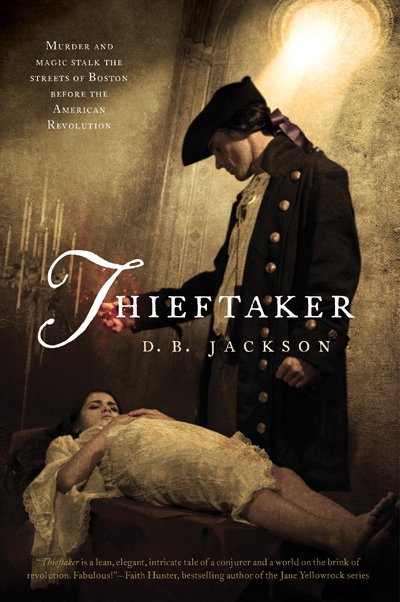
I’m pleased to have author D. B. Jackson here today to talk about his new historical fantasy mystery release, THIEFTAKER, set in colonial Boston.

By the way, this is what I said about the novel: Thieftaker is an excellent blend of mystery and magic set in the turmoil of Colonial Boston as revolution brews and political factions collide. The setting is vividly painted, and the story is a fine portrait of a man caught between his bitter past and its legacy, and the constant dangers and reversals that dog his attempts to build a new life for himself.”


Did you know that throughout his adult life, Samuel Adams was afflicted with a mild palsy that made his head and hands tremble?  I hadn’t known either.

Did you know that women in Colonial Boston — and other North American cities in the second half of the 1700s — enjoyed a good deal of financial and social independence, and that it was not at all uncommon to find single women, usually widows, running their own shops and taverns?

How about this one:  Did you know that in the 1760s, at least until the British occupation of the city began in the autumn of 1768, Boston had only one law enforcement official of consequence?  It’s true.  His name was Stephen Greenleaf and though he was Sheriff of Suffolk County, he had no officers at his command, no assistants to help him keep the peace, save for the men of the night watch who were almost universally incompetent, or venal, or both.

My newest book, THIEFTAKER, which was released by Tor earlier this week, is the first book in a historical urban fantasy series set in pre-Revolutionary Boston.  The series follows the adventures of Ethan Kaille, a conjurer and thieftaker, as he solves murders and grapples with the implications of the deepening divisions between the colonies and the Crown.  I have a Ph.D. in U.S. history, and though I often used my history background in the worldbuilding I did for my earlier fantasy novels, this is the first project I have undertaken that allowed me to blend fully my interest in history and my love of fantasy.

Not surprisingly, I had to do a tremendous amount of research for THIEFTAKER, its sequel (THIEVES’ QUARRY, Tor, 2013), and several related short stories.  And one of the things that struck me again and again while I was reading through documents and monographs, was that so much of the past is lost to us in the glare of Important Events and Important People.  As Kate put it to me as we were exchanging ideas for this post, “What about the history that isn’t taught?”
By way of example: THIEFTAKER begins on August 26, 1765, a night when a mob of protesters rioted in the streets of Boston to vent their frustration at Parliament’s passage of the Stamp Act.  (In the book, the riots coincide with a murder that Ethan has to investigate.  But I digress.)  The homes of several British officials were ransacked, most notably that of Thomas Hutchinson, the Lieutenant Governor of the Province of Massachusetts Bay.  Hutchinson blamed James Otis and Samuel Adams for much of what happened that night, viewing them, with some justification, as the leaders of the growing rebel movement.  But one name you almost never find in history textbooks is that of Ebenezer Mackintosh.  Great name, right?  You might think that a man with such a name would attract some historical attention, especially when you learn that he was the leader of the mob responsible for so much destruction and subsequent political upheaval.  But though as a co-called “street captain” he had a strong following among laborers and unskilled workers in Boston, he was never “important” enough in more formal political circles to draw the attention of scholars.  That said, he does play a crucial role in THIEFTAKER, as do Samuel Adams and Sheriff Greenleaf.

In addition to learning about some of the people who don’t usually find their way into “taught” history, I also learned a tremendous amount about the city of Boston itself, including the ways in which city officials sought to adjust to circumstances as population centers grew, making urban life more complicated.  During the middle decades of the eighteenth century, Boston experienced a number of devastating fires, not least among them the Great Cornhill Fire of March 20, 1760.  This fire began at a tavern called the Brazen Head and swept through the South End down to Boston Harbor, destroying three hundred forty-nine buildings and leaving more than a thousand people homeless.  Miraculously, no one was killed.  (I should note here that I have written a short story about this event — “The Tavern Fire” — which appeared in the AFTER HOURS: TALES FROM THE UR-BAR anthology edited by Joshua Palmatier and Patricia Bray.  The story can now be found at the D.B. Jackson website.

The spate of fires that struck Boston changed the cityscape.  After Boston’s Town House burned to the ground in the fire of 1711, the new one — the now famous Old State House — was rebuilt in brick.  In the aftermath of the 1760 fire, city leaders passed an ordinance mandating that all new construction in Boston be done in brick or stone rather than wood. Faneuil Hall, which was destroyed in the Cornhill fire, was rebuilt in 1761 in its present form, again in brick.  Moreover, noting that attempts to combat the blaze were hampered by lanes that were too winding and narrow, city officials also decreed that several of the smaller lanes in the Cornhill section of the city be widened and straightened.  As a result of the fires, Boston in 1765 looked far more like a modern city than it had only half a century before and by the end of that year, many of the landmarks we associate with Boston were already in place.

Finally, to bring this discussion full circle, I should add that in the aftermath of the Cornhill fire, one of Boston’s tax collectors refrained from demanding payment from those citizens most grievously affected by the catastrophe.  He had no permission from his superiors to do this, but he felt that those most in need should be relieved from having to pay.  His name?  Samuel Adams, of course.  As it turns out, Adams might have been a political genius, but his personal finances were a mess.  Several times, he almost lost his home at auction because of his personal debts.  And his poor relationship with money extended to his early public service.  In the early 1760s, a committee of the town meeting did an audit to determine why the city of Boston suddenly found itself in a financial crisis.  The audit determined that tax collectors had failed to bring in some four thousand pounds owed by the citizenry.  Adams alone was responsible for more than half of the shortfall.

These lesser known historical facts are more than entertaining.  They are tiny gems that make a historical narrative sparkle, that add depth and flavor and richness to a historical setting.  Getting the details right on things like the Stamp Act and even the riots that took place the night of August 26, 1765, was relatively easy.  Over the years, much has been written about those topics.  But the “untaught” history, the small details that are harder to find, are also the ones that catch readers by surprise, that draw them deeper into both character and story.  And, I have to admit, they are also the rewards of historical research that I value most.  After all, readers aren’t the only ones who need to be entertained; this should be fun for us writers, too.

*****
D.B. Jackson is also David B. Coe, the award-winning author of a dozen fantasy novels. His first book as D.B. Jackson, Thieftaker, volume I of the Thieftaker Chronicles, will be released by Tor Books on July 3. D.B. lives on the Cumberland Plateau with his wife and two teenaged daughters. They’re all smarter and prettier than he is, but they keep him around because he makes a mean vegetarian fajita. When he’s not writing he likes to hike, play guitar, and stalk the perfect image with his camera.

Maps (and miscellaneous)

1) Thank you to all who offered recommendations for light, humorous reading material. It is much appreciated. I’m going to get a selection of things and then see what sticks. Should be fun.

2) The winner of the copy of THE SHADOWED SUN by N.K. Jemisin was Kate P from the UK. Congrats!

3) There is a map of Europa in Cold Magic, and a map of North Amerike and the Antilles in Cold Fire. There may be a slightly more detailed map of Europa (or at least a part of it) in Cold Steel. Here’s your chance to request other map subjects, if indeed you have any. Is anyone interested in a map of the cities of Adurnam or Expedition?

I know that some love maps, some are indifferent, and some dislike them. That’s as it should be.

I personally like maps, because I’m geeky that way but also because I process information both visually and kinesthetically, and thus maps make it easier for me to negotiate certain kinds of plots. Yet with other stories, I don’t even think of wanting a map. I wonder if there is a kind of story that seems more to benefit by a map while others just don’t have any call for them.

There are narratives in which there are things about the world you can’t learn from the story but which you can glimpse if the book includes a map, so in that sense a map can add a bit of extra dimension to a world. One of the challenges of writing the Spiritwalker books in first person is that there is a lot of information about the world that can never get into the narrative because it isn’t something a) the narrator would reflect on much less know &/or b) that is necessary to the plot.

In world building as it happens on the page, I believe there is another way at looking at “mapping.” By this I don’t necessarily mean an actual drawn graphic map as a representation of a place, but a map of geography and society and history that is created in the mind of the reader as s/he walks through the story.

Secondary world stories (a term commonly used to describe stories that are set in worlds that are not this world) have to walk a fine balance. If you pile in too much detail, then it slows down the pace and drive of the story (I’m not immune to this writing flaw). However, if you put in too little detail, then the danger becomes that readers will mentally fall back to a “standard.” That is, they may read onto the world a kind of generic medieval-Europe (or British Victorian or whatever) setting regardless if that is the one there. If a story is set in a Europe-inspired setting, then this is not a problem. But if the story is not meant to be set in that landscape, the writer (I think) has to invest a little more detail and explanation to differentiate their world from the sort of world people so often expect to see in, say, fantasy novels. Of course, again, too much detail and the narrative bogs down. The endless cycle thereby continues: What to show? What to leave out?

How do you write or read through this balance?


I need book recommendations

Please recommend to me light, humorous mainstream novels appropriate for a broad-minded 85 year old man recovering (splendidly, but still . . . ) from surgery. Probably not Prachett or other sff-related genre humor as he is not an sff genre reader (although he has read all of my novels). But the humor can range afield from, say, the Kingsley Amis type “comic” novels or Wodehouse. IOW, something more recent and maybe not just from a white male academic perspective, if you see what I mean.


He just read a grim Icelandic WWII/Cold War thriller, and wants a break and something more hopeful and uplifting. Not cloying, though. Satirical is all right, but surely there recent mainstream comic novels out there that would please.


Thanks in advance.

Book sign/reading from Cold Steel in L.A. in July

I’ll post this twice more as the time grows closer, but I want to announce that I will be doing a book signing together with the wonderful fantasy writer Lynn Flewelling on

SATURDAY JULY 28 at 2:30 pm

at Mysterious Galaxy Redondo Beach (Los Angeles)

I will read from COLD STEEL. I might even let the audience vote on which of several short excerpts they want me to read from . . . Rory getting naked? Bee telling off powerful men? Cat punching, well, anything?

Also, I will have hard copy pamphlets of the bonus chapter 31.5 from COLD FIRE available (I’m not charging for them).

As always with this kind of signing, you can bring your books from home for me to sign, and that is perfectly fine, but it is also courteous (and useful!) to make a purchase (of some kind, not necessarily my books) from Mysterious Galaxy, the hosting indie bookstore, because they have to sell books to stay in business in order to host signings and readings like this one.

Also, if you cannot attend the signing, you can place an order beforehand and get a signed (and personalized, if you wish) copy of any of my books which they have in stock, which they will then ship to you afterward.

I would love to see you all there.

Just as an FYI: I plan to attend the Sirens Conference in mid October (near Portland, Oregon), and may do a signing at Powells at that time. I also plan to attend World Fantasy Convention in Toronto, Canada in early November.